

Local focus to strengthen Indian pharmaceutical manufacturers
For the Indian pharmaceutical industry, competitiveness not only means access to international markets, but also establishing expertise and operational capabilities on an equal footing directly in India. This is precisely what pharmaceutical machinery manufacturer Romaco supports as it implements a strategic realignment: namely, localising the production of format parts for blister packaging machines of the successful Noack 900 series in India. Sanjeev Nimkar, Managing Director of Romaco India, Amol Nikam, Director of Customer Service at Romaco India and Gero von Stackelberg, Director of Customer Service at Romaco Group, explain in an interview with Express Pharma what this means for Indian pharmaceutical manufacturers and how this commitment to the Indian market came about

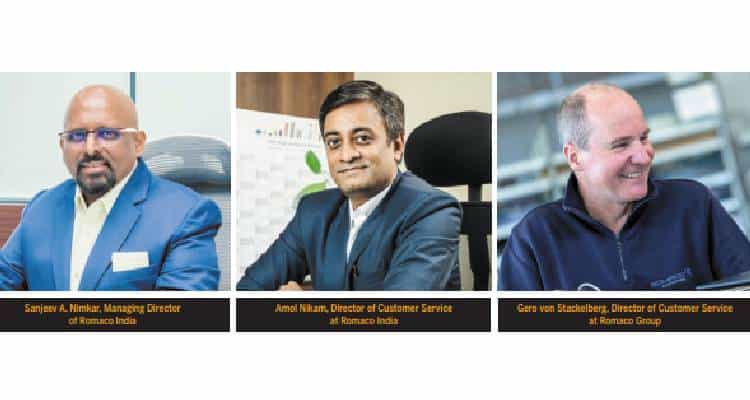

Why is localising format part production an important step for Indian pharmaceutical companies and Romaco?
Sanjeev Nimkar: It makes it easier for Indian manufacturers who want to benefit from the advantages of our blister packaging machines, such as excellent OEE, high output and great quality, to access our equipment. The local production of format parts tremendously reduces delivery times, which makes our customers more flexible, minimises downtime and speeds up the commissioning of newly purchased machines. This is not only due to shorter delivery routes, but also to the elimination of considerable organisational workload and bureaucratic hurdles. Previously, test material and placebo tablets had to be delivered to Germany for all work on new format parts, which has become very costly and time-consuming in recent years given the sometimes very strict import regulations and customs rules. Among other things, this resulted in considerable air freight costs and significant effort in preparing the export documents. Localisation in India now makes all this complexity obsolete.
What was also crucial for us in terms of localisation was that these fast delivery times do not compromise the quality of the format parts and end products. The blister packaging manufactured with the parts produced in India has the same quality characteristics in terms of tightness and sealing properties as European output.
Amol Nikam: The localisation is also supported by the availability of the blister machines at our Romaco India Experience Centre in Hyderabad, for running in and approving new format parts, as well as for adjustments to existing formats. Film tests and operator training can additionally be carried out in the modern customer and training centre, which also includes a spare parts warehouse and a process technology laboratory that combines Romaco’s expertise in the areas of granulation, tableting and coating of pharmaceutical solid products.
With the localisation of the format part production and the Experience Centre, we can now provide even better blister production support to Indian pharmaceutical manufacturers and help them achieve the fastest possible ROI. This includes having Indian technicians on site in Hyderabad who have been trained on the blister packaging machines at Romaco headquarters in Germany by our experts from Romaco Noack and thus have the expertise to locally train or directly assist customers in India.
Gero von Stackelberg: All of this shows why the localisation is a milestone for Romaco India and Romaco as a whole. Decentralisation and customer focus have always been core objectives of the Romaco Group – and format part production in India is the practical realisation of this.
And it will not stop there: Within the next months and years, most of the format parts required in India will also be designed here.
What was central to the implementation of localisation in India?
Amol Nikam: Teamwork was key here. In order to implement this approach “local for local”, as a local production that directly addresses customer needs, we collaborated internationally. The strategic placement of this step was carried out by management from Germany, while the organisational work and concrete implementation was executed in India. Overall, it can be said that we at Romaco are exploiting international opportunities to support our Indian customers and help to shape the global growth of the Indian market with attractive solutions.
Gero von Stackelberg: A perfect example of this international collaboration for the benefit of the customer is the combination of expertise from Germany, Romaco White Line machine production in China and format part manufacturing in India. This enables us to combine quality, speed in delivery and cost efficiency.
Romaco is a sustainability enabler. Does localisation reflect this?
Sanjeev Nimkar: Absolutely. Of course, localising the production of format parts in India is primarily intended to guarantee our customers a quick start to production, flawless machine operation and a secure supply of format parts. But localisation is also a matter of sustainability. For example, it is directly related to our sustainability strategy, as the shorter transport distances have a positive effect on the carbon footprint of the machine components.
Gero von Stackelberg: Additionally, sustainability is also achieved in the sense of further developing not only the market in India, but the Asian market as a whole. This commitment is illustrated, for instance, by the Noack N 950E, the first blister packaging machine to be installed at the Customer Experience Centre in Hyderabad, which was manufactured at Romaco Changsha in China. In other words, the localisation in India is an investment in the future.