

Safeguarding the pharma excipients supply chain
Adding excipient details to QR codes of the top 300 drugs may not be a tough task. But as CDSCO plans to expand QR codes to cover other critical drug categories in phases, all segments of the pharma value chain need to tighten their systems, analyses Viveka Roychowdhury



From March 1 this year, the Quick Response (QR) Codes or barcodes on the labels of the top 300 medicine brands in India have to include “qualitative details” of excipients used during the making of these products. This amendment to the Sub-Rule 7 of Rule 96 of the Drugs Rules, 1945, sometimes referred to the QR code amendment, is part of the larger regulatory reform rolled out by the Central Drugs Standard Control Organization (CDSCO) in December 2023, which resulted in the revised Good Manufacturing Practice norms under Schedule M.
Though the QR code amendment might seem routine, it is anything but. In a recent blog post, titled, Advanced excipients: India’s gate to high-value drug formulation, Saransh Chaudhary, President – Global Critical Care,Venus Remedies and CEO,Venus Medicine Research Centre (VMRC) explains the significance thus, “For the first time, excipients are moving from the background to the foreground of regulatory scrutiny. Ingredients once treated as passive “fillers” are now central to how India will be judged on transparency, safety and quality. In that sense, excipients are no longer peripheral. They are becoming one of the levers that can shape India’s future competitiveness in complex formulations.” (https://www.expresspharma.in /advanced-excipients-indiasgate-to-high-value-drug-formulation/)
Looking at “regulation as a catalyst, not a constraint”, Chaudhary’s article points out how the revised Schedule M guidelines, together with the broader quality framework under ICH Q8, Q9, Q10 and Q12, are reshaping how Indian manufacturers think about quality by design. “The new excipient labelling mandate under Rule 96 adds another layer of discipline. Requiring the qualitative disclosure of excipients on the innermost container for relevant products is more than a labelling change. It improves traceability, strengthens pharmacovigilance and makes it easier for regulators, prescribers and patients to understand what goes into a medicine. Over time, this can help build trust in Indian brands in both domestic and export markets.”
The trigger for change
Excipients have proved untrustworthy in the recent past. Cough syrups containing non-medical grade diethylene glycol (DEG) and ethylene glycol (EG) have been linked to the deaths of more than 140 children in India, Gambia, and Uzbekistan. Last year, DEG was linked to the deaths of 22 children in Madhya Pradesh.
Referencing these instances, Rishi Agrawal, CoFounder and CEO, TeamLease RegTech opines that repeated violations in India’s pharma ecosystem are rooted in predictable blind spots rather than isolated misconduct. He highlights weak raw material governance, particularly in excipient procurement, pointing out that DEG/EG contamination episodes have consistently traced back to inadequate supplier qualification and insufficient incoming material testing.
Clearly, the QR code amendment aims to weed out the use of unsafe excipients from underqualified suppliers. The resulting reputational loss, threat to India’s image as the “pharmacy of the world”, and negative impact on pharma exports, has also triggered questions in Parliament, putting pressure on regulators to crack down and institute reform.
As Ashishchandra Rao, Partner, Economic Laws Practice recalls, “The government in answering questions in Rajya Sabha Unstarred Question No. 293 (02 December 2025) and Lok Sabha Unstarred Question No. 293 (13 February 2026) mentioned that the QR Code Rule is a regulatory and enforcement measure after the deaths caused due to cough syrup counterfeits.”
Emphasizing the rationale, Rao says, “The main aim for including details of excipients within QR codes/barcodes is patient safety. Adverse reactions can arise from excipients such as parabens, dyes, or lactose, rather than the active drug. Hence, the 2025 amendment requires QR Codes on Schedule H2 drugs to include qualitative excipient details, enabling users to access this information as full lists cannot fit on small packages.”
Other obvious goals are increased transparency and pharmacovigilance. Rao points out, “The QR Code reduces information gaps about drug formulations. It is also easier for regulators to find batches if there is a safety issue when they record excipient details at the pack level. This lets them do more focused investigations or recalls. The requirement also builds on India’s existing QRbased track and trace system for the top 300 brands, which is meant to make the supply chain more visible and curb the counterfeit drugs menace.”
There are plans to expand QR code requirements beyond the top 300 brands. Future phases are expected to cover critical categories such as narcotic and psychotropic substances (NDPS), vaccines, anti-cancer drugs and anti-tubercular medicines. Implementation will likely occur in a phased manner through further amendments or administrative orders
– Dr Santosh Indraksha Deputy Drugs Controller (India), CDSCO, DGHS, Ministry of Health and Family Welfare, Government of India
For the first time, excipients are moving from the background to the foreground of regulatory scrutiny. Ingredients once treated as passive “fillers” are now central to how India will be judged on transparency, safety and quality. In that sense, excipients are no longer peripheral. They are becoming one of the levers that can shape India’s future competitiveness in complex formulations
– Saransh Chaudhary President – Global Critical Care, Venus Remedies and CEO, Venus Medicine Research Centre (VMRC)
Policy in practice
How prepared are pharma companies to implement this new mandate, given that they have had six months to comply?
Secretary, IPEC India and CEO, Nitika Pharma applauds the policy saying, “The amendment to Rule 96(7), effective March 1, 2026, is a significant and timely step toward strengthening transparency and patient safety in India’s pharmaceutical sector. While the mandate is directed at finished dosage manufacturers, excipient manufacturers are central to making this initiative meaningful and implementable. We are already seeing our customers — pharma companies, CDMOs and bulk drug manufacturers — seeking greater traceability, standardised excipient identification and more structured technical documentation. At Nitika Pharma, we have proactively begun aligning our systems to support this shift, as we believe excipients are not just inactive ingredients but critical contributors to drug quality and performance.”
He however cautions that implementation will require careful calibration. “Challenges such as non-standardised excipient nomenclature, complex multi-excipient formulations, and digital readiness — particularly among smaller manufacturers — need practical regulatory guidance. A phased rollout and harmonised naming framework would significantly ease adoption across the industry,” is his recommendation. Looking ahead, Dr Khurana says, “From a policy standpoint, enabling QR codes to link to centralised digital repositories and issuing clear guidance on qualitative disclosure will further strengthen this initiative while reducing compliance burden.
Overall, this is a progressive move that elevates India’s pharmaceutical quality standards globally. As both Secretary of IPEC India and CEO of Nitika Pharma, I believe close collaboration between regulators and industry will be key to ensuring that this initiative delivers real value for patient safety, supply chain transparency and global competitiveness.”
An industry expert from Merck points out, “The March 1, 2026 Gazette Notification under Rule 96(7) of the Drugs & Cosmetics Rules, 1945 requires manufacturers of specified Schedule H2 finished drug formulations (as listed by CDSCO) to include qualitative details of excipients in the QR code or barcode on the product label (primary packaging, or secondary packaging where space is limited). In practice, implementation of this labelling requirement sits with the manufacturers of the relevant finished formulations; excipient suppliers are not required to add QR or barcode information under this mandate. Excipient suppliers can support pharmaceutical manufacturers by ensuring excipient quality through rigorous testing, consistent manufacturing processes, and adherence to international pharmacopeial standards, and by providing documentation that supports transparency and traceability across the supply chain.”
One segment of India’s pharma brands might find it easier to comply. As Rao analyses, “The top 300 Indian drug brands under Schedule H2 (top 300 brands) of the Drugs Rules, 1945, (Drugs Rules) were already required to print bar codes and QR codes on their labels carrying eight core data points such as product and manufacturer identifiers, batch number and expiry date, under Rule 96 (7) of the Drugs Rules since 2023 (QR Code Rule). A new coding obligation is not created under the Drugs (Second Amendment) Rules, 2025, rather it extends this existing framework by requiring manufacturers of Schedule H2 formulations to also encode the qualitative details of excipients used in each product. Hence the further obligation is with respect to the data and not the hardware.”
To comply with these rules, Rao says most pharma companies have preferred to print a dynamic QR code i.e., a link to a webpage on the packaging as opposed to a static QR code. This does not add any additional costs for pharma companies already complying with the QR Code Rule as the details of the excipients can be updated on the webpage link and the printed QR code need not be changed. According to him, with regards to printing the QR Code itself, bigger domestic and multinational manufacturers are better able to comply with the QR Code Rule.
A widening regulatory divide?
Given that regulatory oversight is set to increase, will such amendments widen the divide between larger pharma companies which already comply with the previous mandate for the top 300 brands, while pharma MSMEs struggle to comply?
For instance, Rao draws attention to a further Notification G.S.R. 173(E) dated March 9, 2026, Draft Rules published by the Ministry of Health and Family Welfare (Department of Health and Family Welfare) for the proposed amendment of the Drugs and Cosmetics Rules, 1945 whereby in Rule 74 of the Drug Rules, sub rule g(i) to g(vii) are to be inserted. As per the proposed amendment, manufacturers are to now notify the licensing authority in writing of any changes in the manufacturing process, ‘excipients’, packaging, shelf life, specifications, testing or documentation.
He explains that this is an additional safeguard proposed to be added as dynamic / webpage-based QR Codes can be updated unilaterally and very easily, leaving changes only at the level of the webpage and would effectively move excipient control ‘off-label’ and outside the regulated approval/variation system.
TeamLease RegTech’s Agrawal opines that India’s pharma regulation is moving towards enforcement-led control owing to the risk to life, triggered by repeated incidents of contamination with DEG/EG which hampered India’s credibility as a global supplier.
He also points out that quality failures escalate because regulatory information and operational response are disconnected. He advocates the use of digital compliance infrastructure to bridge that gap by converting regulatory change into executable workflows. He suggests that a structured compliance platform integrated with notifications from the CDSCO and state regulators can trigger automated alerts for banned formulations, labelling changes, or revised Schedule M requirements. At the manufacturing level, digital tracking of excipient sourcing, vendor qualification and batch-level testing can create real-time exception reporting, reducing dependency on post-facto audits.
At present, there is no specific CDSCO or Drugs Rules provision that itemises, in a detailed matter, what precise ‘details of excipients’ must be provided or encoded for purposes of the QR Code Rule requirement. The amendment simply adds a requirement to capture ‘qualitative details of excipients’, without further sub-categorisation. Such generalisation of requirements in labeling often results in wide ambiguity as to the actual purpose for which the requirement was intended
– Ashishchandra Rao Partner, Economic Laws Practice
Industry feedback
As per ELP’s Rao, “Industry representatives have mostly agreed that starting with the top 300 brands was a good initiative. The popular opinion is that even if QR printing is a big ‘change control’ in manufacturing processes, it is a way to build the ecosystem before expanding to other areas of industry.”
Calling the excipient amendment “a data governance exercise” for manufacturers that have already invested in serialisation, QR printing, and integrated packaging/IT systems to meet both export requirements and the existing Schedule H2 mandate, Rao states that despite official statistics not being available at the moment, a reasonable inference can be drawn from how these companies have handled earlier QR Code Rule compliance.
Rao opines that companies that depend on contract manufacturing are less prepared for the QR Code Rule, recalling that when the top 300 brands rule was introduced, industry commentary noted that small and mid-sized firms would face financial and operational challenges to implement the QR Code Rule. The cost of 2D printers, vision systems, and integrating code-generation software with basic ERPs can be significant and may also slow production lines.
Overall, Rao believes that the sector had a head start on infrastructure but not full compliance. Since 2023, it appears that the top 300 brands have complied with the QR Code requirements. The excipient requirement only adds to the information in those codes starting on August 18, 2025, and companies had until March 1 this year to comply.
However, Rao points out, “CDSCO hasn’t made clear adoption data available, which makes it hard to figure out how well everyone is following the rules. Often times, bigger manufacturers are equipped for the implementation, but smaller companies and brands have trouble with the same.”
Repeated violations in India’s pharmaceutical ecosystem are rooted in predictable blind spots rather than isolated misconduct. The first is weak raw material governance, particularly in excipient procurement. DEG/EG contamination episodes have consistently traced back to inadequate supplier qualification and insufficient incoming material testing
– Rishi Agrawal Co-Founder and CEO, TeamLease RegTech
Ambiguity in the amendment
The QR code amendment also needs more clarifications. Sounding a cautionary note, Rao points out, “At present, there is no specific CDSCO or Drugs Rules provision that itemises, in a detailed matter, what precise ‘details of excipients’ must be provided or encoded for purposes of the QR Code Rule requirement. The amendment simply adds a requirement to capture ‘qualitative details of excipients’, without further sub-categorisation. Such generalisation of requirements in labeling often results in wide ambiguity as to the actual purpose for which the requirement was intended.”
From a legal and regulatory perspective, Rao posits that the most reasonable reading is that at a minimum, excipient-related information that is functionally analogous to the data fields already prescribed in Rule 96 (7) for the finished formulation i.e., clear identification of the excipient substances used (names/identifiers), sufficient to allow traceability and pharmacovigilance, but not extending to disclosure of proprietary know-how.
From a policy standpoint, enabling QR codes to link to centralised digital repositories and issuing clear guidance on qualitative disclosure will further strengthen this initiative while reducing compliance burden. Overall, this is a progressive move that elevates India’s pharmaceutical quality standards globally. As both Secretary of IPEC India and CEO of Nitika Pharma, I believe close collaboration between regulators and industry will be key to ensuring that this initiative delivers real value for patient safety, supply chain transparency and global competitiveness
– Dr Ravleen Singh Khurana Secretary, IPEC India and CEO, Nitika Pharma
A question mark over QR codes
The irony is that counterfeiters have already found ways to subvert QR code based systems. Rao highlights that QR Code technology may not effectively prevent counterfeit medicines and may even create a false sense of authenticity. He points out that counterfeiters have been able to replicate medicine packaging including the QR Code so precisely that scanning the code on fake products can still return a message confirming the pack as genuine.
Giving an example, Rao cites one documented case involving counterfeit versions of an anti-epileptic drug, where each fake blister pack carried a different active QR Code with a unique serial number, meaning that scans did not reveal duplication and instead validated the counterfeit product as authentic.
As he explains, “This suggests that QR Codes, which are relatively easy to replicate or compromise through digital theft of serial-number banks, can be manipulated by sophisticated counterfeiters. As a result, the system may fail to detect fake medicines while misleading consumers and regulators into believing that a counterfeit product is legitimate, thereby undermining the very objective of the policy.”
Giving the CDSCO’s perspective on this front, Dr Indraksha acknowledges the importance of establishing a robust “parent-child” traceability system, where each unit can be tracked back to its origin. However, efforts made to implement such systems— led not only by regulators but also by the Directorate General of Foreign Trade (DGFT)—have faced resistance. He points out that industry reluctance, particularly among MSMEs, is attributed to the costs and complexity of adopting advanced traceability technologies. As a result, earlier requirements for such systems were withdrawn in 2025 by DGFT.
Policy recommendations to safeguard the pharma excipients supply chain
While regulatory reform signals intent, will intent translate into monitoring and enforcement? As Agrawal stresses, “Regulatory capacity must expand in proportion to industry scale. Oversight of excipient sourcing, testing and certification cannot rely on limited laboratory infrastructure or inspection bandwidth. India requires a stronger network of accredited testing laboratories, trained inspectors and digital monitoring systems capable of tracking high-risk inputs such as solvents and glycerin derivatives across the supply chain.”
Secondly, pointing out that regulatory certainty is critical for manufacturers and suppliers, he recommends that clear and stable standards for excipient quality, supplier qualification and batch-level testing should be uniformly enforced across states. Predictable regulatory guidance reduces ambiguity for manufacturers while ensuring that compliance investments are directed towards well-defined quality benchmarks rather than shifting enforcement priorities
Thirdly, excipient supply chains require structured traceability and verification mechanisms. Agrawal mentions that mandatory supplier qualification protocols, authenticated certificates of analysis and digital batch traceability should become standard practice for highrisk excipients. Integrating manufacturers, accredited laboratories and regulators through interoperable digital systems can enable real-time reporting of test results and quality deviations, significantly reducing the risk of contaminated inputs entering pharmaceutical production.
Agrawal’s final recommendation is that encouraging domestic manufacturing of high-risk excipients, building strategic supplier networks and creating risk-based import monitoring systems can reduce dependence on opaque global supply chains.
Expanding the regulatory net
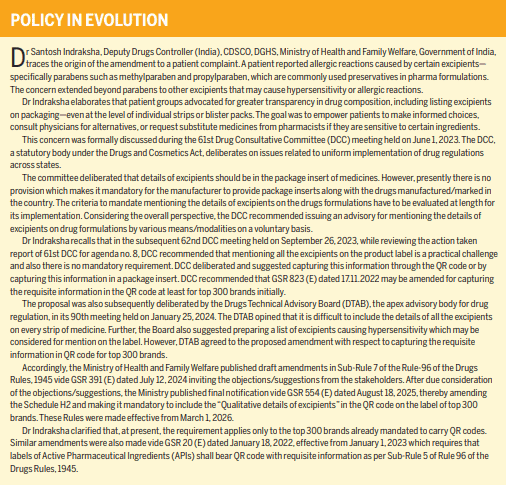
Dr Indraksha confirms that there are plans to expand QR code requirements beyond the top 300 brands. Proposals have already been discussed and approved in principle by both the DCC and DTAB. Future phases are expected to cover critical categories such as narcotic and psychotropic substances (NDPS), vaccines, anti-cancer drugs and antitubercular medicines. “Implementation will likely occur in a phased manner through further amendments or administrative orders,” says Dr Indraksha.
Choosing to see a silver lining in the higher regulatory compliance, Venus Remedies’ Chaudhary believes, “India stands at a crossroads where excipient innovation can meaningfully reshape its position in the global pharma value chain. Moving from commodity-grade materials to engineered, functional excipients is not just a scientific upgrade; it is a strategic one. It underpins manufacturing modernisation, strengthens regulatory credibility and opens new export avenues.”
He points out that over the next decade, as continuous manufacturing becomes more common and biologics gain a larger share of pipelines, excipients will only grow in importance. To realise this opportunity, large companies, smaller manufacturers and early-stage innovators will need to work in the same direction: towards advanced materials, data-informed formulation design and alignment with international quality expectations.
Signing off on a positive note, Chaudhary predicts that if India can combine regulatory reform, scientific capability and purposeful investment, advanced excipients may well become one of its most important advantages in the next phase of pharmaceutical growth.
When the familiar is no longer safe
Perhaps the additional stress on the quality and provenance of pharma excipients will prepare the sector to deal with novel excipients, especially those used in biologics. In a LinkedIn blogpost, titled, Grassroots and GRAS: Rethinking Safety, Consciousness, and Responsibility in the Age of Novel Excipients, regulatory consultant Dr Ajaz Hussain reminds us that in pharmaceutical science, a mundane ingredient can carry the heaviest consequences. (https://www.linkedin.com/pulse /grassroots-gras-rethinkingsafety-consciousness-age-hussain-ph-d–fcoae/)
Dr Hussain, a former Deputy Director Office of Pharmaceutical Science, CDER, US FDA (January 1995 – October 2005) who now describes himself as an Advisor in Regulatory Drift, Technocratic Tensions & Historical Collapse, reminds us that the acronym GRAS, or Generally Recognised As Safe, grants substances exemption from FDA premarket approval if a consensus of qualified experts deems them safe for their intended use. As he terms it, “GRAS represents a legacy shortcut—a permission slip based on familiarity rather than fresh scrutiny.”
He goes on to ask: “What happens when familiarity fades? What if the “generally recognised” consensus is inherited, not earned? This becomes more than a regulatory question when novel excipients—like ionizable lipids used in lipid nanoparticle (LNP) formulations for mRNA vaccines—enter the scene. Unlike traditional food or drug excipients, these synthetic lipids lack the GRAS pedigree.”
Perhaps the way forward is Dr Hussain’s parting advice, on a philosophical note, “As excipients move from the margins to the center of pharmaceutical innovation, so must our collective consciousness. In time, what we once called “inactive” may be recognised as the functional ingredient, not just in our formulations but also in our frameworks for moving closer to the truth, trust, and transformation. If we aspire to transform our technologies and ourselves, then the path forward is not to dismiss dissent, but to evolve our capacity to hear critically, compassionately, and courageously.”
As India’s pharma sector gears up for higher regulatory scrutiny, all segments need to move in sync. Each segment is a link, small or large, in the life sciences value chain. A chain is only as strong as its weakest link. Excipient makers, pharma companies and regulators will have to work together to shore up this weak link.