

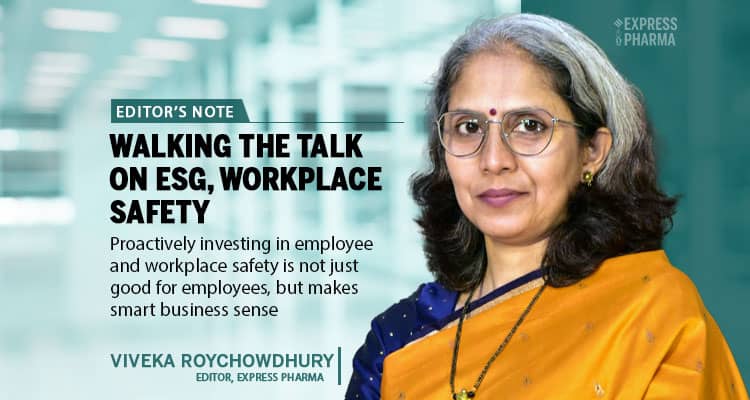
Walking the talk on ESG, workplace safety
Proactively investing in employee and workplace safety is not just good for employees, but makes smart business sense


“IDMA CARES should become what Indian pharma represents, not just in molecules but in morals.” This was Daara Patel, Secretary General, Indian Drug Manufacturers’ Association (IDMA), setting the tone on July 18, at the launch of IDMA CARES, an initiative which aims to strengthen workplace safety, Prevention of Sexual Harassment (POSH), and Environmental, Social, and Governance (ESG) principles. Express Pharma was a Media Partner for the launch, and we’ll be featuring a detailed report soon, but here are a few hard-hitting comments that stayed with me.
Patel reiterated that “POSH, ESG are not just good ethics but smart business sense”, while Bharat Shah, National President, IDMA, stressed that the industry cannot claim to save lives while polluting rivers, and must therefore deliver safe medicines while ensuring safe workplaces.
Neha Thakore, Chairperson, ESG Committee – IDMA, stressed that “doing good is no different from doing well” and urged pharma companies to consider laws like POSH as “reputational insurance” and reframe their identity as “not just manufacturers but stewards of trust.”
For me, the highlight of the IDMA CARES launch was a panel discussion where Aditi Kare Panandikar, Managing Director, Indoco Remedies and P S R K Prasad, Director, Natco Pharma, shared how their companies have implemented sustainable practices. Meher Pudumjee, Chairperson, Thermax Group, highlighted that ESG is “not compliance but a competitive advantage” and is a “ticket to the world” with more regulators moving to cleaner, greener regulations around chemicals.
The panel was moderated by Sandeep Mohanty, Partner – Sustainability Transformation, PwC India, who stressed that global clients are making it mandatory for suppliers and vendors to follow Scope 3 emission norms. Thus, “sustainability does pay”, as it ensures ESG-compliant companies have a competitive edge vis-à-vis those that do not follow global ESG norms.
While many pharma companies have started on the ESG path, we have a long, long way to go. More importantly, the message has to filter down the line to suppliers and vendors. The recent explosion at Sigachi Industries, where as many as 46 people died at its Pashamylaram plant in Sangareddy district, Telangana, is the latest warning that workplace safety, a key part of ESG, needs to be a top priority too.
The Sigachi Industries’ Q1 FY26 results statement hints at the soul-searching and introspection within senior ranks of the company, resulting in a ‘strategic realignment post Pashamylaram’. Amit Raj Sinha, MD & CEO, Sigachi Industries, called the Q1 FY26 “an emotionally and operationally challenging quarter”, acknowledging that “the tragic incident led to the loss of lives and injuries among our workforce, and we extend our deepest condolences to all affected.”
The company has started the disbursal of interim compensation under the ex-gratia financial support package for the 46 families of the deceased and eight staff members who remain unaccounted for. Interim payments have also been made towards injury compensation and continues to support the families of three members still under medical care.
“This event has prompted a comprehensive review of our operational controls and risk governance,” says Sinha. “Looking ahead, we are committed to a decisive reset, prioritising safety, accelerating cost improvements, focusing on margin-led portfolios, and rebuilding with global standards, resilience, and transparency. With the lessons behind us and our resolve strengthened, we are confident in our ability to deliver sustainable growth and improve EBITDA margins.” This transparency is to be applauded and encouraged, and one hopes to see the company rebuild not just bigger but better than before.
Sigachi Industries is by no means the only company to have such incidents. On a recent post Q1 FY26 earnings call, Ashok Nair, Managing Director, RPG Life Sciences, disclosed that the company’s API business had a temporary sales impact due to a fire incident at their Navi Mumbai-based API manufacturing plant in January. Thankfull,y there were no casualties, and as per Nair, “a dedicated team of 155 professionals is working on restoring the plant with a completion target in Q2.”
“RPG Life Sciences is built on a people-first, safety-first culture” and Nair credits the emergency response team, the RPG Group’s long-standing manufacturing expertise across sectors from tyres to infrastructure and good insurance coverage that will allow the company to recover and get back on track. 85 per cent of APIs manufactured at the impacted plant were exported, 15 per cent were for the domestic market.
These statements underline the multiple ramifications of such incidents. At an individual level, such incidents leave a scar on the lives of the affected individuals and their families. At a company level, rebuilding physical infrastructure will have to go hand in hand with rebuilding trust with employees and clients. Thus, proactively investing in employee and workplace safety is not just good for employees, but makes smart business sense.
However, one wonders how many such tragedies remain unreported in smaller, unlisted companies, especially those in far-flung industrial manufacturing zones? Do employees and their families receive adequate help with medical expenses and compensation for injuries and deaths? There are many MSMEs that serve the pharma industry, and not all of them are as visible as listed companies who are mandated to inform stock exchanges and answer to investors. Therefore, one has to assume that the incidence of such accidents and death tolls would be much higher.
While larger companies have the organisational bandwidth to disburse compensation (offset by partly insurance, etc) and recover from the business setback, many other companies are not in the same position. They would prioritise a back-to-business policy, without rectifying faulty practices, and employees would remain at risk.
Such incidents could tarnish the image of India’s pharma industry as a whole, just as promising bilateral agreements like the recent India-UK Free Trade Agreement (FTA) fructify after years of negotiation. UK PM Keir Starmer in fact reportedly termed it “the most significant deal since the UK left the EU.”
Namit Joshi, Chairman, Pharmexcil, underlines that with India’s pharma exports to the UK reaching $914 million in FY24, the India-UK FTA agreement strengthens supply chains, enhances access to affordable medicines, and drives Foreign Direct Investment (FDI).
According to his statement, this partnership paves the way for collaborations in bulk drug imports, CDMO, and joint research, empowering India’s competitive edge and promoting global partnerships.
India’s pharma sector is already globally connected and has a reputation to uphold. Thus, besides the moral case of putting employee safety first, workplace safety makes good business sense. If only to avoid disruptions to production schedules, revenue erosion and reputational damage.
Viveka Roychowdhury, Editor