

Panel Discussion: Overcoming barriers in drug discovery and development

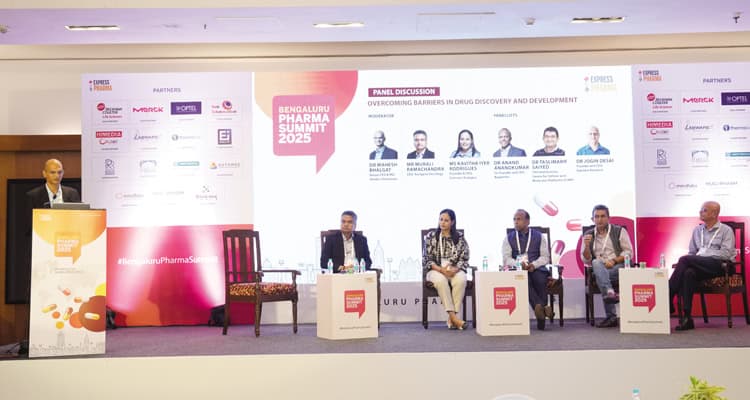

Drug discovery, from molecule to patient, is long, risky, and expensive. India has world-class scientific talent and a rapidly growing biopharma ecosystem, yet barriers remain. For instance, how to fund and sustain early discovery, how to accelerate clinical validation, and how to take Indian science global. These critical issues were explored in the panel discussion at Bengaluru Pharma Summit 2025.
This discussion had a stellar panel which included Dr Mahesh Bhalgat, Group Chief Executive Officer & Managing Director, Veeda Lifesciences (Moderator); Murali Ramachandra, Chief Executive Officer, Aurigene Oncology; Kavitha Iyer Rodrigues, Founder & Chief Executive Officer, Zumutor Biologics; Dr Anand Anandkumar, Cofounder & Chief Executive Officer, Bugworks Research; Dr Taslimarif Saiyed, Chief Executive Officer & Director, Centre for Cellular and Molecular Platforms (C-CAMP); and Dr Jogin Desai, Founder & Chief Executive Officer, Eyestem Research.
The session highlighted a pressing challenge — antimicrobial resistance (AMR). India loses nearly 400,000 lives every year to AMR, yet funding for this critical area remains extremely low. The panelists stressed that wWhile programmes such as the Research, Development and Innovation Scheme have been positive steps, they require faster and more efficient execution to create a real impact on biopharma research and development.
Financing was a central theme throughout the discussion. The panel highlighted that traditional funding models are inadequate for drug discovery, where high costs and long timelines discourage investment. To overcome this, there is a pressing need for blended financing models, larger grant pools, and stronger public–private partnerships. These models are essential to derisk innovation, sustain early-stage research, and encourage risk-taking in high-potential areas.
India’s innovation advantage was also underlined. The experts pointed out that solutions developed here can address the dual challenge of affordability and accessibility, making them relevant both for domestic needs and for global markets. However, the panel emphasised that achieving this requires sustained investments, bold funding strategies, and a willingness to embrace risk.
Another focus was the role of clinical data. India generates vast amounts of clinical information, but its true potential lies in building stronger partnerships to analyse and apply this data effectively. The shift from being suggestive to being predictive was identified as a major step forward. Predictive models, supported by clinical and real-world evidence, can transform drug discovery by improving clinical validation, reducing costs, and delivering better patient outcomes.
Technology was seen as the engine that can accelerate progress. Artificial intelligence, machine learning, and digital platforms are reshaping the way drug discovery is carried out. Integrating these tools with traditional science can shorten timelines, improve efficiency, and expand the scope of discovery.
The panel also emphasised the critical role of talent. India has an exceptional scientific workforce, but the future demands professionals who are not just skilled but also driven by purpose, nimble in their approach, and quick to adapt. Developing pathways for young researchers, strengthening academia–industry collaborations, and fostering a culture of innovation were seen as essential steps to power India’s next wave of R&D leadership. Bengaluru was highlighted as an important hub for discovery. The city is becoming a hotspot for innovation in areas ranging from oncology to infectious diseases. With its strong mix of start-ups, global pharma players, and academic institutions, Bengaluru provides a model of how ecosystems can drive discovery momentum across the country.
The key takeaway from the session was clear. India’s future in biopharma innovation lies in moving from incremental progress to transformative breakthroughs. By combining its talent pool, technological strengths, and innovative financing with sustained collaboration, India can not only address its own healthcare needs but also create solutions for the world.