

Innovation made in India
As the world closes its doors and builds walls, India can chart its own course by leading the next wave of affordable, accessible pharma innovation. This feature, first in a three-part series, examines India's opportunity to drive progress in global healthcare through science, scale and purpose



When India innovates, the world benefits. And we’ve seen this proven time and again. Take the Mars Orbiter Mission (MOM), for instance. With just Rs 450 crore, India reached Mars on its very first attempt. A notable feat that showed what’s possible with home-grown, fearless innovation.
In fact, there are examples where even popular culture has taken note. In the Netflix series Space Force, there’s an episode where the US military learns of an Indian rocket launch and scrambles to find out whether there has been a leak of information. Later, when it’s revealed that India simply built its own technology, a character concludes, “So India was just… smarter.” This captures a growing global realisation that India is now a nation capable of world class innovation.
India’s pharma story too has several such examples. During the HIV crisis, Indian pharma made life-saving drugs affordable, reducing the cost from over $10,000 to under $80 a year. During the COVID-19 pandemic, India didn’t just protect its own citizens, it became one of the world’s largest vaccine suppliers, with indigenous vaccines like Covaxin holding its ground with global ones.
But such stories shouldn’t remain exceptions; they must become the norm. And, that calls for a clear, collective strategy, one that unites science, policy and industry. Today, it’s no longer a choice but an imperative. As the world closes its doors and innovation becomes increasingly inaccessible, India must build the bridges. And, if we invest in research, nurture talent, and create an ecosystem where innovation is not by chance, but by design, we have a clear opportunity to lead. Why? Let’s examine the global scenario to understand.
The India advantage
According to the recently released Cytiva Global Biopharma Index, global biopharma revenues rose eight per cent in 2024 and are expected to grow nearly 10 per cent annually through 2029. Yet, nearly half of companies missed their revenue and profit targets. While there is innovation, it is not translating into business success. Thus, the world’s biopharma sector is in a flux. The index highlights the need for a robust ecosystem that will thrive on policy, people, digital readiness, manufacturing agility and sustainability.
And, this is where India has a clear advantage because it checks most of these boxes. India rose five places in Cytiva’s 2025 rankings, to become one of the top 10 biopharma ecosystems globally, ahead of France, Canada and Australia. The report links this rise to three things: a deep generics base, rising R&D investment and rapid digital adoption. It states that India “punches above its income weight.” In simple words, we’re doing more with less, and doing it well.
The numbers support this finding. India’s bio-economy crossed $165.7 billion in 2024, as per the India BioEconomy Report 2024. It contributes more than four per cent of GDP and has been growing at a CAGR of nearly 18 per cent over four years. Moreover, India’s strength in generics and vaccine manufacturing is formidable. Together, these signal that India must position itself for innovation-led growth.
And, here are some of the key ‘windows’ India can step through, opportunities can drive growth, both at home and globally.
Upping the value game
There has been a growing realisation that India can no longer be just a manufacturing hub. We cannot wait for innovation to happen elsewhere and then scale it. We have to originate it. We cannot compete on cost alone. Fortuitously, industry leaders are already signaling this shift through investments in R&D, global partnerships and manufacturing upgrades.
For instance, Serum Institute is building capabilities in mRNA and next-generation vaccines. Sun Pharma, Lupin and Dr Reddy’s are investing in novel therapies and digital platforms. To cite a recent example, in the second quarter of this financial year, reportedly Sun Pharma’s US sales of innovative medicines surpassed its generics sales for the first time.
Leverage manufacturing at global scale
India’s manufacturing strength is robust with proven capabilities in generics, vaccines and bulk APIs. Now, India can play a leadership role in global supply-chains as an innovation partner, with strategic measures.
In pharma and biotech this means shifting from mere “cost competitiveness” to “make what is new, better and globally competitive”. This includes novel biologics, gene/cell therapies, advanced devices, digital therapeutics. This also aligns with the path outlined in the BioEconomy Report 2024 report which states, “India’s vision for the bioeconomy is rooted in innovation-led growth, sustainable development, and inclusive economic progress. The country aims to become a global hub for bio-manufacturing, backed by strong R&D infrastructure, cutting-edge technologies, and a skilled scientific workforce.
The focus is on creating a resilient industrial ecosystem that promotes the development and commercialisation of new biotech products, while unlocking opportunities in both urban and rural regions. With an ambitious target of achieving a $300 billion bioeconomy by 2030, India also seeks to lead globally in bio-pharma, including vaccines, diagnostics, and therapeutics. This strategy directly contributes to the broader goals of India@2047, emphasising sustainability, economic selfreliance, and green growth.”
However, it means not just more firms, but more complex manufacturing, more biotech startups, deeper upstream work so that global pharma, med-tech and diagnostics players can look to India, not just for cost benefits but for co-innovation.
Tackling global health challenges
India’s large population, digital public infrastructure, price sensitive market and famed ingenuity also make it a great choice for high-impact solutions at low cost. From diagnostics to drug delivery, India can build for itself and export to global markets, especially those with similar constraints.
India is also positioned to do global good in key areas like neglected diseases, affordable biologics or access-driven models. The convergence of science, manufacturing, access and digital gives India a unique advantage, particularly when global geopolitics, tariffs, supply chain fragility and rising cost pressures are accentuating the need for diversified, resilient innovation hubs.
Pathways to progress
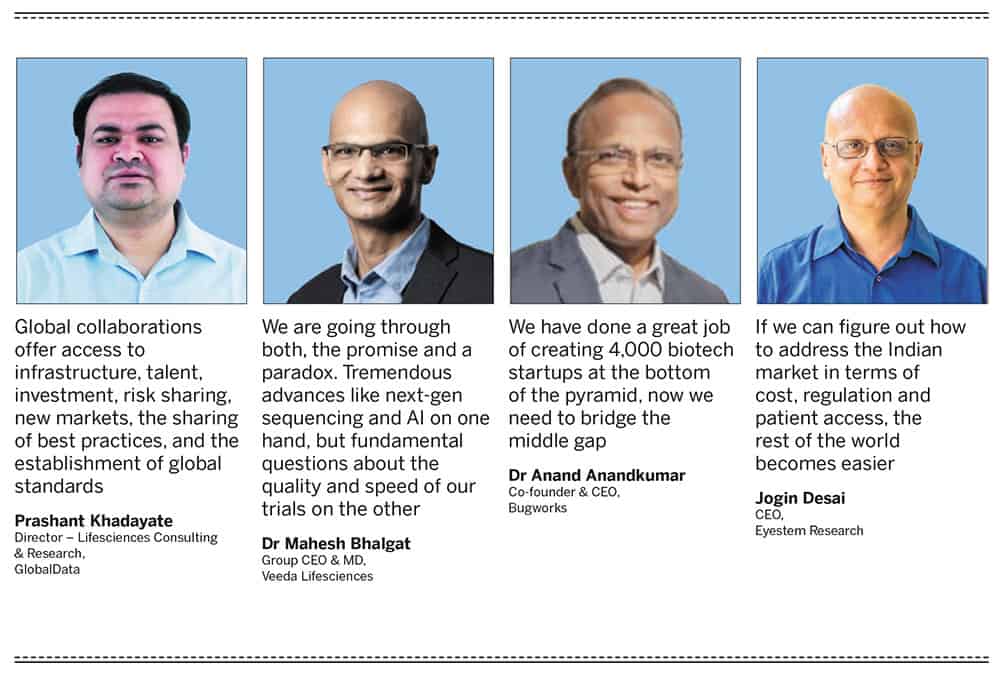
However, as Prashant Khadayate, Director – Life-sciences Consulting & Research, GlobalData, explains, India’s pathway to becoming a global innovation partner will require systemic reform and stronger collaboration.
He elaborates, “For India to establish itself as a global partner in innovation, the country needs to focus on continuous regulatory reforms, collaboration between industry and academia, and improvements in innovation infrastructure, access to funding, and incentives. India has been making progress in these areas; however, there is still a long way to go from an innovation perspective. Furthermore, concerted efforts from both the government and industry could significantly advance India’s innovation ambitions. In addition, India must enhance the quality of research in local academia and attract top Indian research talent from around the world to leverage their expertise on a much larger scale.”
He adds that China’s experience offers valuable lessons. Over the past decade, China implemented sweeping reforms from streamlined drug approvals to pricing and reimbursement incentives. These measures have propelled it into a major innovation-led pharma hub. The creation of high-quality innovation clusters further accelerated commercialisation and global integration.
China moved from a ‘me-too’ model to a global innovator in under a decade. If India can couple its scale and science talent with policy consistency and infrastructure, we can do the same, perhaps faster, opines Khadyate. He states, “Global collaborations offer access to infrastructure, talent, investment, risk sharing, new markets, the sharing of best practices, and the establishment of global standards. Additionally, these collaborations can accelerate the overall innovation cycle, from execution to successful outcomes.”
A recent panel discussion hosted at Express Pharma’s Bengaluru Pharma Summit also offered some great insights on similar lines. Dr Mahesh Bhalgat, Group CEO & MD, Veeda Lifesciences, who was the moderator for this session, shared that we are going through both the promise and a paradox. On one hand there’s a huge amount of advances like next-gen sequencing, AI, data. On the other hand, there are still basic questions we need to address: how well are our trials designed, are they getting faster, are they getting leaner?
A sentiment that captures where India stands today, a point of inflection. Other panelists also offer great inputs on why India needs a scalable innovation ecosystem. Dr Anand Anandkumar, Cofounder and CEO, Bugworks points out that while we have done a great job of creating 4,000 biotech startups at the bottom of the pyramid, we haven’t been able to move up. We need to bridge that middle gap and create an ecosystem that can take companies from seed to scale, from Rs 50 lakh to $200 million.
That “missing middle”, the stage between seed and scaleup, is where India’s next breakthrough stories will be written.
He also notes that India must chart its own model of innovation. He says, “We will never be China and we don’t need to be.” But if we use AI and tech smartly, we can create our own model. India’s stack is damn good, we put a billion people on a vaccine database. Let’s build on that.
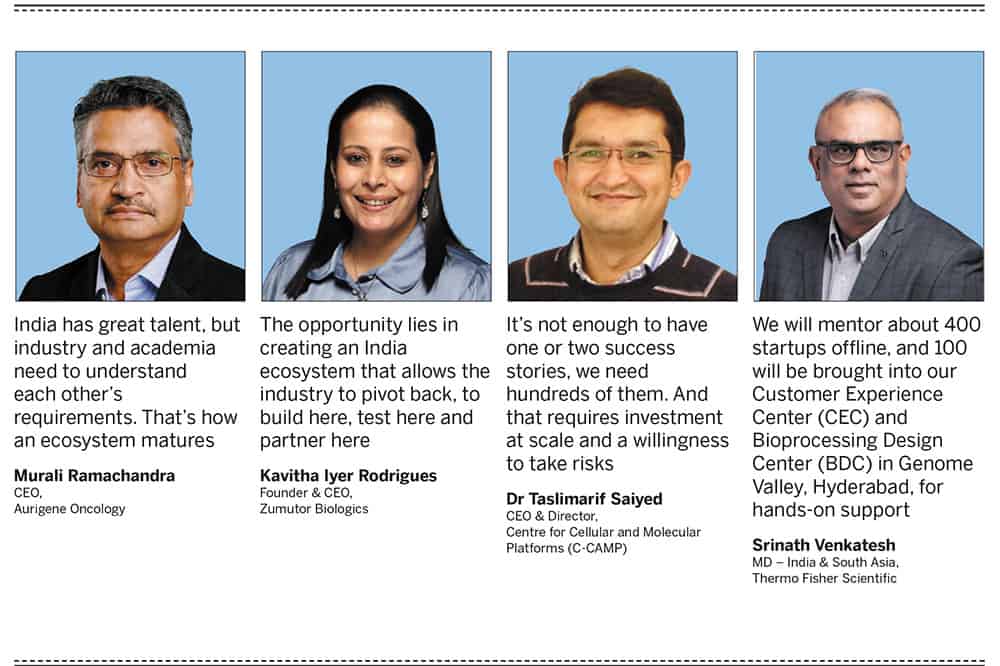
Jogin Desai, CEO, Eyestem Research, reinforces this thinking and says that if we can figure out how to address the Indian market in terms of cost, regulation, and patient access, the rest of the world becomes easier. India is the right place to build affordable, scalable innovation. Murali Ramachandra, CEO, Aurigene Oncology stresses the need for tighter industry-academia linkages since talent and collaboration remain at the heart of the ecosystem’s evolution. He highlighted that India has great talent, but industry and academia needs to understand each other’s requirements. That’s how an ecosystem matures.
During the discussion, the message was reiterated several times that innovation isn’t just about capital or infrastructure, but about meaningful connections.
Kavitha Iyer Rodrigues, Founder & CEO, Zumutor Biologics is a strong advocate for decisive action. She believes that the time to act and play is now. Drawing from her organisation’s US-first model, she says that the opportunity lies in creating an India ecosystem that allows the industry to pivot back, to build here, test here and partner here. She asserts that India’s innovation ecosystem can and must become more self-sustaining. A place where discoveries can be born and built locally, before expanding globally.
The policy push
And policy will be the real key to building such an ecosystem. Fortunately, the government has taken some crucial steps in this direction with initiatives like the Promotion of Research and Innovation in Pharma MedTech Sector (PRIP) and the RDI Fund. These programmes seek to drive research-led growth in India. PRIP, with an outlay of Rs 5000 crore, aims to build world-class R&D infrastructure, set up Centres of Excellence at NIPERs, and promote strong collaboration between industry and academia.
Yet, policy must go beyond funding. To truly unlock India’s potential, we need faster regulatory clearances, flexible clinical trial frameworks, strong IP protection, and incentives that reward innovation. The focus should be on creating an environment where new ideas can move quickly from lab to market. Building on this point of view, Dr Taslimarif Saiyed, CEO and Director, Centre for Cellular and Molecular Platforms (C-CAMP), opines that the right funding mechanisms are crucial. He emphasises that it’s not enough to have one or two success stories. We need hundreds of them. And that requires investment at scale and a willingness to take risks.
He adds that recent policy moves could catalyse that growth if executed with vision and speed. Schemes like PRIP and RDI can be game changers. If implemented well, they can fund not just seed ideas but also scale-up innovation.
Partnerships that build
The industry and government are also coming together in other ways to strengthen India’s innovation foundation. In an earlier interview with Express Pharma, Srinath Venkatesh, MD – India & South Asia, Thermo Fisher Scientific, points to Thermo Fisher’s partnership with Startup India under DPIIT, called the BioVerse Challenge as an example of how this collaboration is taking shape.
The endeavour is to identify and support 500 startups across medtech, biopharma, biophysics, and proteomics. “We will mentor about 400 startups offline, and 100 will be brought into our Customer Experience Center (CEC) and Bioprocessing Design Center (BDC) in Genome Valley, Hyderabad, for hands-on support,” he explains. This model, where global players help nurture India’s startups, can also make innovation scalable and sustainable.
Inclusive innovation: The way forward
India’s strength lies in its ability to build inclusive innovation, not innovation for the few, but for the many. But its innovation story is still being written. In its labs, startups and policies. The ecosystem is maturing and global partners are looking to collaborate. The time to build that bridge is now. With the right vision, measures and partnerships, India can redefine global healthcare.
(The next articles in this series will look at India’s challenges on this innovation journey and outline the way forward toward realising its ambition of becoming a hub for pharma innovation)