

India at a jumping-off point in terms of commitment to global clinical studies
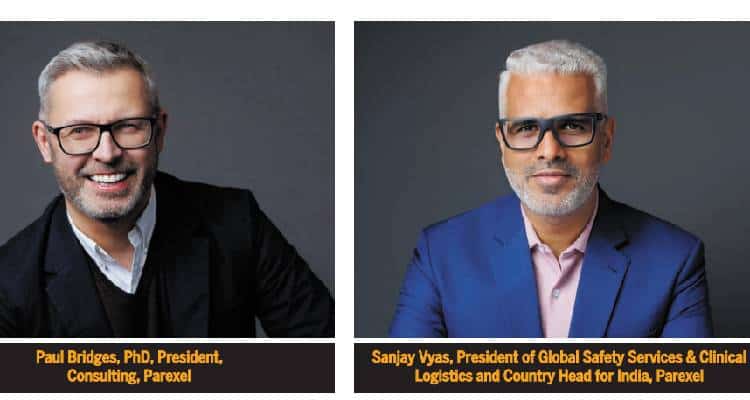
Paul Bridges, PhD, President, Consulting, Parexel, and Sanjay Vyas, President of Global Safety Services & Clinical Logistics and Country Head for India, Parexel, shortlist trends that will define 2026— from data protection uncertainty and AI governance to biosimilars’ second wind, inspection readiness and India’s emergence as a global clinical trials hub. Excerpts from a wide-ranging conversation with Viveka Roychowdhury


If you were to pick one or two trends in clinical trials and research in India in 2026, what would you be looking at? What are the trends you would track, worry about, or watch closely?
Sanjay Vyas: For me, one is the new data protection act that has just come in (the Digital Personal Data Protection Act, 2023 (DPDP Act)). There is still a lot of uncertainty. Even though the act states that if you use local patients and local vendors you need to ensure data protection, for outside vendors it may not be required. I want to see how this will be implemented.
As a CRO, I am not worried because we are already very high on compliance and data protection processes. But the skepticism remains around how data will be captured, where it will reside and how it will be reported. That is one trend I will definitely track.
The second trend that continues to keep me slightly awake is the applicability of artificial intelligence and machine learning. We are still behind in issuing clear guidelines compared to the US FDA and EMA. They have been very proactive. We have even had a seat at the table with the US FDA, where our chief data officer served as a consultant. They are asking questions like what tools are you using and where AI is being applied across clinical trial processes.
We have not reached that stage in India yet. I would like to see that progress and some clarity emerge.
The third is early phase trials, especially first-in-human studies. I hope that at some point the doors open further and the environment becomes more conducive so that drugs can be made accessible to patients earlier, rather than waiting until phase two or phase three.
Paul Bridges: So probably the topic I would address first is Indian companies. These are well funded companies with decades, sometimes hundreds of years, of experience, now taking that knowledge and technical capability and applying it to far more innovative areas of research and development, perhaps through that biosimilar bridge to true innovation.
Some of the changes we are seeing in the US market are triggering this shift. Indian firms looking to penetrate the world’s largest global market now have to commit. Questions come up around transferring manufacturing sites to the US and other related decisions. That is a significant commitment and, in my view, it can only really be supported by true R&D investment.
So the first hot trend is conversations with very capable and credible global sponsors in India about their pipeline and their approach to conducting clinical development globally. That is what has brought me here this week, day after day of conversations with companies that have done well in generics, have had early success with biosimilars, and now want to target the next wave.
Secondly, biosimilars are seeing renewed emphasis. There is a sort of second wind behind the biosimilar opportunity because the US FDA and EMA have waived some of the phase three clinical requirements for biosimilars. A number of candidates coming off patent are becoming more attractive biosimilar targets because of this.
That said, this does not mean clinical trials are no longer required for biosimilars. Very important PK studies still need to be performed, along with observational studies. I would strongly advocate that sponsors maintain close dialogue with regulators around the world to understand how these new guidelines translate into operational reality.
That is where Parexel is very active right now, helping sponsors understand that they do not get a free pass on clinical studies, but that those studies can be smaller, more focused and more targeted. So this represents a second opportunity, that second wind behind biosimilars.
Finally, is the emergence of India as a potential global hub for clinical trials and clinical trial conduct. Many of the elements are falling into place. There are also areas that need more focus, including public awareness of the importance of clinical trials and greater willingness to engage in earlier phase studies. But I see India as being at a jumping-off point in terms of commitment to global clinical studies. We have seen similar trajectories in China and other jurisdictions.
Vyas: Recently, the US FDA conducted a surprise inspection for one sponsor in Korea. That trend is increasing.
With the mandate coming from the Prime Minister’s Office and the DCGI, and with new audit and inspection processes starting in 2026, there is a clear directive. The revised Schedule M also plays a role here, with a focus on getting manufacturing in India to a level of confidence aligned with US FDA and global GMP standards. This will be a critical trend to watch in 2026. With all the attention drawn by incidents like the cough syrup cases and other situations, we recently had a symposium where a local DCGI official in Ahmedabad stated that it is now a clear mandate for every pharma manufacturer in India to operate at the highest standards. The goal is to reach a point where US FDA surprise inspections are no longer an exception, but compliance at that level becomes the norm.
So you are inspection ready at all times?
Bridges: I am really glad you raised that. This is a massive issue. For a number of years post COVID, and then following the post election disruption in the FDA, inspection activity slowed down. Inspectors were not getting out into the field, and there was staff attrition. As a result, enforcement activity declined.
The new US administration has been very clear that they want a leveling of the playing field between domestic US manufacturers and global sponsors. We have been telling our sponsors to be prepared, because the FDA will be coming, and inspections will now be unannounced.
Historically, Parexel would receive a call from an Indian or Korean sponsor saying they expected an inspection in a few months and needed help preparing. We would engage, identify issues and fix them. That is no longer the case.
We are also seeing an uptick in inspection activity. There are more inspectors in the field. As Sanjay mentioned, we recently heard from a sponsor who had the FDA turn up unannounced, identify issues and threaten import alerts and restrictions into the US.
This is a big deal. It would not have happened 12 months ago. We expect more of this in India as well. Framed positively, as Sanjay said, this is a great opportunity to take a leap forward in the context of the global opportunity we have been discussing today.
It is about improving processes, strengthening data flows, using tools like AI in manufacturing, and, overall, being inspection ready. That readiness is a very important topic.
It can also be seen as a regulatory moat. Those who reach that level gain a competitive edge?
Vyas: It is no longer possible for us to sit back and remain only the generics capital of the world. We have to become the pharma manufacturing hub of the world. It does not matter whether it is generics, biosimilars or anything else, because the CDMO industry is also growing rapidly, especially in this part of the world. After what has happened, confidence levels in China have gone down a bit, so there is a clear opportunity for India to take a leap of faith and leverage that further. There is one more point that struck me, which is the emergence of new innovative medicines coming out of India. One trend I have seen among pharma sponsors is that they are starting to look beyond biosimilars to new molecules.
Cell and gene therapy, perhaps unfortunately or fortunately, initially came from academia, with IIT being one of the first to approach it from that perspective. However, many Indian multinational pharma sponsors that I have spoken to have now, in some form or another, started exploring the development of cell and gene therapies. This has the potential to reduce the cost of these therapies by almost 60 per cent, which is a significant opportunity that India has. I see this emerging as a positive trend by 2026.
There is absolutely an opportunity here. It is just a matter of investments and the right incentives being provided. Bridges: Going back to manufacturing inspection readiness, it is also worth reflecting on the fact that generic and API manufacturers in India have been given some relief on tariffs for the US market. That is good news. However, what President Trump has given on one hand, he has also signalled that it could be taken away. If manufacturing standards are not at the required level, we could see punitive actions.
So I would expect that any pressure that has been absent from the tariff debate for Indian manufacturers will start to show up strongly through inspections and enforcement.
[email protected]
[email protected]