


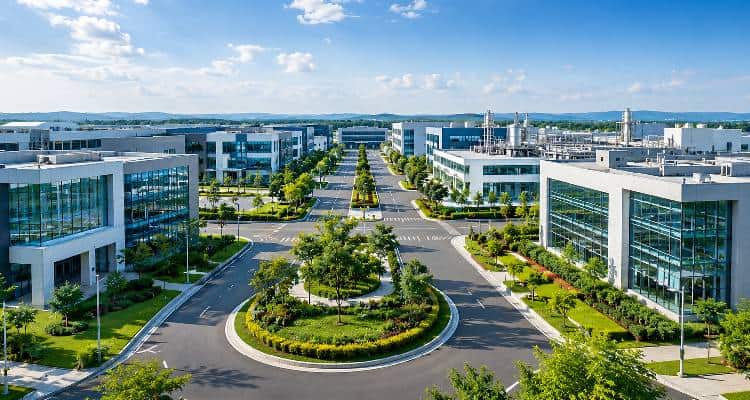

Between the Gulf of Khambhat and the Narmada, India is staking 3,920 crores on the Jambusar Bulk Drug Park in Bharuch, Gujarat.
This is more than an industrial project. It is a strategic statement that India can produce the building blocks of its medicines at scale, at home and at competitive cost.
Over the next five to ten years, how well this park delivers on that promise will determine how effectively India can reduce its import dependence.
The gap India needs to close
India is the world’s largest supplier of generics but depends heavily on imported APIs and KSMs, largely from China. Bulk drugs made up more than 60 per cent of pharma imports in 2021–22. COVID-19 clearly exposed the fragility of this dependence. The Jambusar pharma park is designed as a structural fix to this problem by lowering API production costs through shared infrastructure like effluent treatment, solvent recovery and utilities.
Over the next decade, as global pharma supply chains continue to diversify away from single-source dependencies (a trend driven by geopolitics and events like the pandemic), a fully operational Jambusar park can help India compete with China on price and emerge as a credible alternative in global supply chains.
Why Jambusar
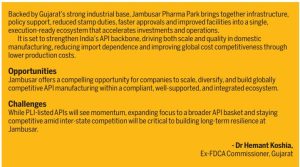
The park’s most compelling differentiator is geography. Bharuch is home to more than 1,300 industries across major clusters including Ankleshwar, Panoli, Jhagadia, Dahej, Saykha and Vilayat, providing direct and indirect employment to nearly two lakh people and contributes approximately 19 per cent to the country’s total chemical exports. Jambusar sits in the middle of this ecosystem, embedded within it.
Ankleshwar alone has over 1,500 chemical plants producing pharma, APIs, intermediates, and specialty chemicals, with a dense network of logistics, regulatory expertise, and technical manpower already in place. No greenfield park in Andhra Pradesh or Himachal Pradesh can replicate this instantly. The solvent suppliers, chemical traders, freight forwarders and regulatory consultants who facilitate API manufacturing are already present in Bharuch district.
The site is within the influence zone of the Delhi Mumbai Industrial Corridor (DMIC), approximately 47 km away, and is around 65 km from the Ahmedabad-Vadodara Expressway, giving it multimodal logistics access to major ports and consumption centres.
Adding to this mix is GIDC’s track record as a state implementing agency. It is one of India’s most experienced industrial estate developers.
The progress so far
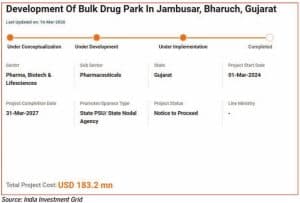
Spread across 2,015 acres (approximately 815 hectares), the park is being developed at an estimated cost of 3,920 crore, with key construction works including approach roads, compound walls, internal road networks, precast drainage systems, internal water supply, and effluent disposal systems underway.
According to the PIB release from February 2026, all civil infrastructure tenders for roads, drainage, water infrastructure, effluent collection, and rack systems have been awarded and work is at an advanced stage of completion. Utility tenders for the common effluent treatment plant (CETP), solvent recovery, and treatment storage and disposal facilities (TSDF) have also been awarded and execution is underway.
A 40-km pipeline to supply water from the Narmada canal is now being laid, the tender for parking facilities was completed in November 2025, and proposals for steam generation are currently under evaluation. Over the next 18–24 months, the park will witness a transition from civil construction to utility commissioning such as CETP, solvent recovery and steam distribution systems. If industrial allotment and unit construction can proceed in parallel, it put the park on track for its stated completion target of March 2027.
The ecosystem edge
Beyond the infrastructure, Jambusar benefits from proximity. Gujarat’s well-established pharma parks such as Ankleshwar provide an ideal ecosystem for API manufacturers. It offers efficient connectivity through ports like Mundra and Kandla for export, and an extensive road and rail network for transportation of raw materials and finished products.
As an established industrial belt, Bharuch has decades of knowledge in chemical process engineering, environmental compliance and hazardous material handling. It also has GIDC-managed estates which offers regulatory familiarity and a workforce trained in chemical manufacturing. So, the Jambusar park does not need to build an industrial culture from scratch. It only needs to amplify one that already exists.
Clear demand signals
The park is designed to house approximately 400 companies. The government has not released a detailed breakdown of allotment applications, but the PLI Scheme for Bulk Drugs, running parallel to this initiative, is a plus. The PLI scheme targets 41 KSMs, intermediates, and APIs, with 48 projects approved across 33 bulk drugs. It focuses on segments like antibiotics, cardiovascular drugs, anti-retrovirals, and oncology, areas where reducing reliance on China is both viable and critical.
Early occupants are likely to be domestic generics companies integrating backwards, CDMOs seeking reliable API supply and mid-sized exporters targeting US and European markets. Interest from global firms looking to reduce China dependence could follow.
Risks are real
However, while the rewards could be high, the risks are real as well. Environmental compliance is the foremost. The park falls partially within Coastal Regulation Zone (CRZ) areas and the deep-sea disposal line for treated effluent requires ongoing regulatory clearance.
Utility commissioning is another challenge. CETP and zero liquid discharge systems take time to stabilise, and delays will slow unit operations and investment inflow. The Gujarat government expects the park to attract large-scale investments from domestic and international pharma companies, but actual private investment inflow depends entirely on how quickly common utilities become reliable and operational.
Finally, China’s pricing remains unpredictable. Any price cuts in response to India’s capacity build-up could erode the viability of domestic API manufacturing. Outlook for 2027–28 Success by 2027–28 will not be full occupancy, but clear momentum.
That means common infrastructure facilities fully commissioned and operational; 150-200 plots under development, and the first units producing and exporting with lower API costs. By 2028, the real test is simple. Jambusar should be able to point to at least one critical API, previously imported, manufactured competitively at scale within the park.
That would be proof of concept. Not just for one park, but for India’s push for Atmanirbharata in pharma. The groundwork is in place. What matters now is execution.
References
- Press Information Bureau, Government of India — Bulk Drug Park Scheme, February 6, 2026. [pib.gov.in]
- DeshGujarat — 40-km Narmada Pipeline Work Begins for Jambusar Bulk Drug Park, April 15, 2026. [deshgujarat.com]
- DeshGujarat — Jambusar Bulk Drug Park Completion by March 2027; Gujarat CM Visits the Site, August 4, 2025. [deshgujarat.com]
- GIDC Pre-Feasibility Report — Project Pre-Feasibility Report, Bulk Drug Park, Jambusar, Bharuch. [environmentclearance.nic.in]
- Gujarat Pharma 2020 / GBReports — Gujarat, India’s Pharma Hub. [projects.gbreports.com]
[email protected]
[email protected]