

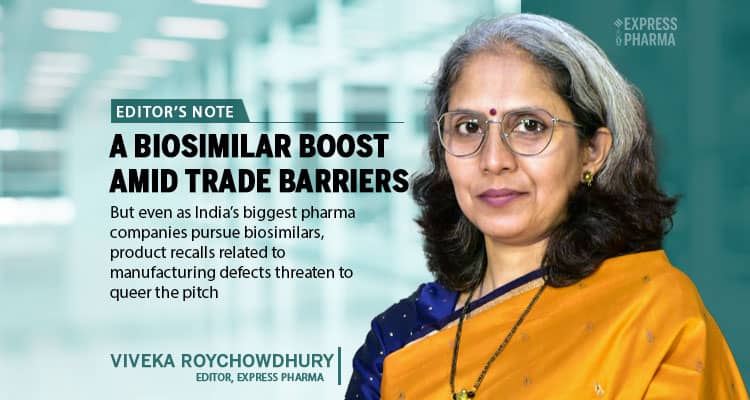
A biosimilar boost amid trade barriers
Even as India’s biggest pharma companies pursue biosimilars, product recalls related to manufacturing defects threaten to queer the pitch


Amidst the uncertainty of 50 per cent tariffs on India, the US FDA’s October 29 draft guidance reducing the need for comparator efficacy studies for biosimilars comes as a welcome silver lining. Though the tariffs do not as yet apply to generics, the uncertainty has been a drag on the Q2FY2026 performances of most pharma companies in India.
Which is why the US FDA’s new guidance got positive reviews from India Pharma Inc. As the US FDA press release points out, despite requiring one to three years and costing $24 million on average, comparative efficacy studies generally have low sensitivity compared to many other analytical assessments. The FDA’s new guidance reduces this unnecessary resource-intensive requirement for developers to conduct comparative human clinical studies, allowing them to rely instead on analytical testing to demonstrate product differences.
It’s a move that will slash development costs and result in more affordable biosimilar medicines for the US market. For biopharma companies, that spells better margins and more incentive to invest in biosimilars.
The draft guidance is part of President Trump’s Make America Healthy Again (MAHA) plan. The US FDA release points out that biologic medications make up only five per cent of prescriptions in the US but account for 51 per cent of total drug spending as of 2024. Market share of FDA approved biosimilars remains below 20 per cent. While there are more than 30,000 approved generics, exceeding the number of approved brand drugs, the 76 US FDA approved biosimilars corresponded to a small fraction of approved biologics. Only about 10 per cent of biologic drugs expected to lose patent protection in the next decade currently have a biosimilar in development.
Clearly the draft guidance aims to attract more players into biosimilar development. It is expected that more of India’s biopharma majors will double down on their biosimilars strategy for the US market.
Calling it a welcome step, Sudarshan Jain, Secretary General, Indian Pharmaceutical Alliance analyses, “The simplification of interchangeability guidelines and approval pathways will create a more enabling environment for the industry to diversify in large-molecule space. India already has nearly 130 approved biosimilars, and over the next seven years, more than 55 blockbuster drugs are expected to lose exclusivity in the US. India has long been a trusted partner in ensuring access to quality-assured, affordable medicines for American patients. These reforms will further strengthen the US–India partnership and our shared goal of improving healthcare access and affordability.”
Even as India’s biggest pharma companies pursue biosimilars, product recalls related to manufacturing defects threaten to queer the pitch But even as India’s biggest pharma companies pursue biosimilars, product recalls related to manufacturing defects threaten to queer the pitch. For instance, atorvastatin tablets made in India by Alkem Laboratories and distributed by Ascend Laboratories in the US had to be recalled as some tablets failed to dissolve. A US-based subsidiary of Sun Pharma had to recall kits of its renal imaging agent. Glenmark Pharma received market complaints about the gritty texture of azelaic acid gel tubes produced at the company’s Goa plant. Both Granules India and Unichem Pharmaceuticals USA had to recall batches of medicines due to “failed impurities/degradation.”
These recalls are worrisome as the resolution sucks up resources which could have been utilised to chase new opportunities, like the development and launch of biosimilars, which are more difficult to develop but promise better margins.
On the home front, Drug Controller General (India) Dr Rajeev Raghuvanshi has asked all state and Union Territory drug controllers to initiate planning to carry out inspections of manufacturing units which had applied for extension of revised Schedule M, from the effective date of January 1, 2026, to verify their compliance.
The November 7 letter also notes that “immediate inspection and action shall be initiated right now for those units who have not applied for the extension, as the revised Schedule M is already applicable for such units.”
Dr Raghuvanshi has also asked all state and Union Territory drug controllers to submit monthly reports on inspections and observations made, and secondly, the actions taken pursuant to such inspections. This is a clear indication that there will be no more extensions of the January 1, 2026 deadline for complying with the revised Schedule M, especially after the deaths of 24 children after consuming cough syrups contaminated with DEG. Will the MSME pharma sector survive the upgrade to revised Schedule M norms? Or will there be a wave of consolidation and attrition?
With the December 2025 edition, Express Pharma completes 31 years of reporting on the pharma sector. From the WTO Agreement on Trade-Related Aspects of Intellectual Property Rights (TRIPS) of January 1995, just a month after the inaugural Express Pharma Pulse edition, to President Trump’s tariffs in 2025, it’s been three decades of growth spurred by challenges. As we get set to close the last edition of 2025, we look forward to continuing to serve the interests of India’s pharma sector in 2026 and beyond.
VIVEKA ROYCHOWDHURY, Editor
[email protected]
[email protected]