

Analytical Ultracentrifugation: A Versatile and Valuable Technique for Macromolecular Characterization

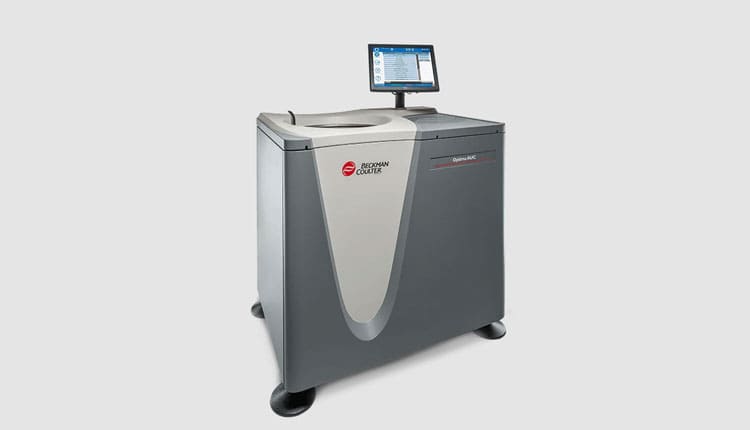

Analytical ultracentrifugation remains a versatile and valuable technique for understanding the fundamental properties of macromolecules in solution. The continuous advancements in AUC technology demonstrate its indispensable role in various fields of research. The most recent AUC instrument, the Optima AUC, introduced improvements such as enhanced wavelength accuracy, allowing more confidence in your measurements. This is especially useful when measuring low-concentration proteins in the 215-230 nm range, where the OD change is steep between wavelengths. Faster scanning capabilities enable the collection of dense raw datasets, which can help improve RSMDs and be useful when collecting information on fast sedimenting analytes. Multiwavelength capabilities, which allow for protein and DNA overlapping signals to be deconvoluted into separate profiles based on their spectral differences, provide direct access to the molar stoichiometry of interacting complexes and improve the characterization of viral vector loading states.
Why downloads this whitepaper?
The whitepaper highlights four recent, high-impact peer-reviewed applications leveraging Analytical Ultracentrifugation and New Optima AUC Analytical UltraCentrifuge advanced features for monoclonal antibodies (mAbs) & aggregate quantification, study membrane proteins, protein-nucleic acid Interactions and viral vectors (AAV Loading States & Contaminants).
