

Resilience by design: The packaging imperative
Global uncertainties are accelerating a strategic shift in pharma packaging, with resilience emerging as a critical driver of continuity, competitiveness, and long-term growth


For a long time, pharma packaging was treated as a back-end function something that got done after the formulation work was complete. The focus was on cost, compliance, and timelines. That view is changing. As geopolitical tensions affect shipping routes, energy prices, and raw material supply, packaging has moved into sharper focus for procurement, supply chain, and leadership teams across the Indian pharmaceutical.
The triggers are well known: Pritam Shimpi, General Manager-Supply Chain, ACG Packaging Materials explains, “Geopolitical risks are now directly influencing pharma packaging operations. Tensions in the Middle East, uncertainty around key trade routes, freight disruption, energy volatility, war risk and insurance premiums, currency movement, and potential trade restrictions, sanctions, or sudden regulatory changes are creating pressure across the packaging value chain. For Indian pharma packaging, the implications are significant because several packaging inputs are linked to global supply networks, crude derivatives, metals, polymers, films, additives, energy, and international logistics. Any disruption in raw material flow, port operations, shipping routes, container and vessel availability or insurance availability can affect lead times, landed costs, and production planning.”
“Pharma packaging has therefore moved from being a cost focused support to a critical supply continuity enabler for pharma customers.”
These are not new developments, but their combined effect on pharma packaging like a function that depends on polymers, aluminium, glass, specialty films, and stable logistics has been meaningful.
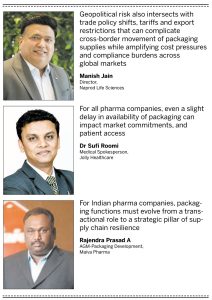
Manish Jain, Director, Naprod Life Sciences, says the impact extends beyond logistics. “Escalating geopolitical tensions, including conflicts in the Middle East and disruptions to critical maritime chokepoints, are creating volatility in global freight, crude and petrochemical markets, directly affecting the availability and pricing of packaging raw materials, increasing transit times, and exposing supply chains to greater risk of delay or interruption. Geopolitical risk also intersects with trade policy shifts, tariffs and export restrictions that can complicate cross-border movement of packaging supplies while amplifying cost pressures and compliance burdens across global markets.”
Jitendra Srivastava, CEO, Triton Logistics and Maritime, offers a view from the logistics side, “One of the biggest lessons from this year’s geopolitical disruptions is that the most critical risks in pharma are often invisible until they affect continuity. What appears to be a shipping issue quickly becomes a manufacturing issue. Extended transit times, rerouting through the Cape of Good Hope, and changing vessel schedules influence production planning, packaging availability, and inventory cycles.”
What has changed on the ground
Giving a market analysis, Ankush Kapoor, Founder, PharmNXT said, “While India’s pharma exports grew by over 5 per cent to $28.29 billion during April-February FY26, the industry’s $32 billion FY26 export target is considered challenging due to tariff uncertainties and geopolitical risks. Achieving this would require exports of nearly $3.7 billion in March 2026, compared to about $1.6 billion in March 2025.
Dhananjay M. Chaudhari, DGM-Packaging Development(Formulations), Indoco Remedies notes, “India’s pharma exports is rising upto almost by 10 per cent year-onyear, showing the broader export momentum behind generics. More than 60 per cent of exports go to stringent regulatory markets, which strengthens India’s reputation as a reliable supplier of affordable medicines. The recent MiddleEast geopolitical crisis raises packaging material costs, tighten supply and increase logistics risk for India’s pharmaceutical packaging.”
The industry’s ability to supply these markets reliably depends, in part, on a packaging supply chain that has historically been built around cost efficiency and singlesource procurement. That approach is now showing its limits.
The most visible impact has been on input costs. Urvee Garg, Director, HAB Pharma, shares what the organisation has seen directly, “Prior to the conflict, PVC was being procured at approximately Rs 115 per kilo; currently, prices have increased to nearly Rs 150 per kilo, although we expect them to stabilise at around Rs 135 per kilo. Similarly, aluminium foil (Alu) prices have surged from around Rs 480 per kilo before the conflict to nearly Rs 650 per kilo now. These are just small examples highlighting the increase in tablet packaging material costs.”
Rajendra Prasad A, AGMPackaging Development, Maiva Pharma provides a wider view of cost movement, “The Iran–US–Israel conflict and disruptions in the Hormuz have emerged as one of the most critical risks in 2026. This has impacted energy supplies (oil, gas), petrochemical feedstocks (critical for plastics and polymers) and global shipping routes. India imports a significant portion of crude oil via this region, and disruptions have caused raw material cost increases significantly in some cases and plastic resin prices from 50 per cent to 60 per cent.
He also notes that, “Recent tariff escalations particularly from the US and EU have introduced higher input costs (metals, polymers, components), uncertainty in export markets and supply chain reconfiguration pressures. Tariffs of 20–40 per cent (potentially up to 200 per cent) on pharmaceutical-related goods are expected to increase cost burdens and force relocation strategies.”
Since packaging materials from PVC and HDPE to aluminium and specialty films are tied to petrochemical and energy markets, any disruption in feedstock supply or energy pricing tends to move through the entire packaging value chain.


The feedstock connection
To understand why pharma packaging is affected, it helps to look upstream. Many packaging materials are manufactured from petrochemical feedstocks such as naphtha, ethylene, and propylene. India imports a significant share of these from the Middle East region.
Chaudhari explains, “Feedstocks such as naptha, ethylene, propylene and other derivatives which India is mainly exporting from Middle-East region is hampered due to Middle-East crisis. Many primary packaging materials such as bottles, blister films production is constrained due to reduced supply or shipping of feedstock causing tightened supply and price hike affects almost all pharmaceutical sector in India.”
On the logistics side, route disruptions have added to the challenge. Shivaji Chakraborty, Head of Packaging Development, Fresenius Kabi Oncology notes, “Attacks in the Red Sea and tensions in the Strait of Hormuz force vessels to reroute around Africa, adding weeks to transit times and sharply increasing the freight costs forcing Indian farms to rethink sourcing strategies.” For temperature-sensitive products, longer transit times also raise questions around product integrity. Chaudhari points out, “Just-in-time inventories with only weeks’ cover are vulnerable — shortages are forcing production slowdowns, product reformulation, or use of inferior substitutes that may affect regulatory compliance or shelf-life.” Dr Sufi Roomi, Medical Spokesperson, Jolly Healthcare shares, “One of the main risks today is overdependence on limited geographies for all packaging inputs, well specialised materials, polymers and other allied suppliers. Any kind of disruption in shipping routes, customs movement, cost of energy and directly impact timelines of packaging and in turn product dispatches schedule. For all pharma companies, even a slight delay in availability of packaging can impact market commitments, and patient access.”
Availability is as much a concern as cost
Rising costs are one issue. The other and in some situations the more pressing one is availability. When supply is tight, materials can go to buyers who pay a premium or commit to advance payments, leaving others with longer lead times or gaps in supply.
Jain says the current environment has exposed structural dependencies in packaging sourcing. “Packaging material availability is being stressed by supply chain dependencies on foreign petrochemical inputs and long logistics corridors, while shipping route disruptions cause lead time volatility and higher insurance and freight costs; this, combined with heavy reliance on imports of specialised materials such as polymers and barrier components, can impede operational continuity and force firms to reallocate inventory, change carriers, or resort to costly expedited shipping.”
Garg describes a specific situation her organisation has faced, “We have one product that is an extremely important brand for us. To prevent counterfeiting, we use a holographic film on the PVC sheet for its packaging. We currently have two approved vendors for this material, both of whom are very large listed companies specialising in high-security packaging solutions. However, even these suppliers are facing difficulties in maintaining consistent supply during the current conflict situation. This, in turn, has a significant impact on our operational continuity.”
The regulatory structure of the pharma industry means that supplier changes are not quick. An alternate source needs to go through qualification, documentation, and change control before it can be used. When even established, approved suppliers face supply issues, companies have limited immediate options.
Shimpi frames the implication for how the industry needs to think about suppliers, “Supplier reliability is no longer measured only by price and quality; it must also include continuity capability, feedstock risk management, early communication, and compliance support.”
Srivastava puts the same point in the context of logistics planning, “The challenge today is less about whether packaging materials are available and more about whether they arrive with the predictability that pharmaceutical operations require. Inputs that once moved through stable freight cycles are now exposed to disruptions that can alter timelines with little warning, creating uncertainty across production schedules and supplier commitments.”
A different kind of risk: Compliance and serialisation
tics, there is a dimension of the geopolitical impact that tends to get less attention: the effect on compliance and serialisation. As trade relations between countries shift, destination markets are introducing their own data and traceability requirements, and these are not always aligned with each other.
Siddharth Reddy, CoFounder, AltiusHub mentions, “The risk most operators underestimate is not material scarcity but regulatory fragmentation. As trade blocs harden, every major destination market is mandating its own serialisation and reporting regime, and they are diverging rather than converging. India exports to over 50 regulated markets, each with its own data format, reporting cadence and national portal. A packaging line that was compliant for one corridor can be non-compliant for another overnight when a regulator updates a mandate. The geopolitical story for packaging is increasingly a data-sovereignty story, not just a logistics one.”
Reddy also highlights an aspect of the hardware supply chain that many quality teams have not had to consider before, “The industry’s dependence on a narrow set of geographies for specialty films, foils, aluminium, and crucially the electronic components inside vision systems and printand-apply hardware, means a single export control or port disruption can idle a line even when the drug substance is available. We have seen lead times on serialisation-grade printers and cameras stretch precisely when shipping lanes get politicised. Packaging continuity now depends on hardware supply chains that most quality teams have never had to think about.”
This points to a broader reality. The packaging function today has more dependencies on materials, logistics, hardware, and data infrastructure than it did even five years ago. Each of these can be affected by geopolitical developments, and they do not all respond to the same mitigation strategies.
How companies are responding
Across the industry, the response to these pressures has broadly moved in a few directions: building buffer stocks, qualifying more suppliers, diversifying sourcing geographies, and investing in supply chain visibility.
Chakraborty outlines the near-term actions being taken: “Build safety stock of imported packaging materials, viz., aluminium foils, polymers, and inks to absorb shipping delays… use multimodal transport (air, sea and rail) and reroute via Europe or Central Asia to avoid Red Sea bottlenecks… Source packaging materials/raw materials from other countries including Europe to reduce dependency on China and Gulf countries.”
Garg describes the broader pattern she has observed: “Pharma companies are increasingly adopting multi-vendor sourcing strategies and expanding partnerships with domestic packaging suppliers to reduce overdependence on single geographies or suppliers. Vendor qualification programs are also being strengthened to build flexibility and ensure continuity during disruptions. Many organisations are maintaining higher safety stocks for critical packaging materials and investing in better forecasting and supply chain visibility tools.”
Kapoor identifies the shift in thinking this is prompting: “There is a shift away from the lowest cost supply chain philosophy to that of lowest risk qualified supply. This is evident in firms making safety stocks for critical components, qualifying alternative suppliers, regionising critical raw material supplies as well as getting packaging and process containment vendors involved early on in the manufacturing design.”
Srivastava describes this same shift from the logistics side: “The most significant change we are witnessing is a move away from efficiencyonly models toward resilienceby-design. Pharma companies are no longer treating alternate routes as contingency plans; they are becoming part of the network architecture from the outset. Dual-route sourcing strategies, diversified ports of entry, and multimodal flexibility are increasingly standard expectations rather than exceptional measures.”
He also highlights what visibility can do for companies during periods of disruption: “Real-time shipment intelligence allows disruptions to be identified early and responses to be activated before they escalate into operational challenges. The invisible journey of a resilient supply chain lies in its ability to adapt quietly in the background so that manufacturers, healthcare providers, and ultimately patients experience continuity rather than disruption.”
An important context comes from Shimpi: “Alternate sourcing requires quality checks, documentation, validation, customer approval, qualification, change control, and regulatory discipline. For customers, resilience must not mean uncontrolled substitution. It must mean pre qualified, compliant, and approved alternatives.”
The pharma supply chain operates within a regulatory framework that does not allow for quick substitutions, even under pressure. Companies that move too fast on alternate sourcing without following the required steps may create compliance problems that are harder to resolve than the original supply issue.
Sustainability amid disruption
The industry was already working through sustainability commitments when the geopolitical pressures intensified. For pharma packaging, the two objectives: supply continuity and reduced environmental impact do not always point in the same direction.
Dr Roomi reflects, “The industry also needs to balance both sustainability and continuity. Eco friendly packaging is very significant, but it should be practical, compliance and scalable during the essential conditions of supply. Future ready pharma packaging also requires those material which are safe, cost efficient and adaptable to continuous changing regulations.”
Garg is straightforward about the specific challenge pharma faces: “When it comes to sustainability goals, the answer is slightly more complex for the pharma industry. In many other sectors, it is comparatively easier to reduce or eliminate the use of single-use plastics. However, in pharma, where sterility and minimal exposure are critical requirements, it becomes far more difficult to completely move away from plastic-based packaging materials.”
Srivastava notes that sustainability and logistics are now being looked at together rather than separately: “We are also seeing a meaningful shift in sustainability thinking. Packaging design, weight optimisation, emissions, and transport modes are no longer being evaluated independently. Companies are increasingly viewing them as interconnected decisions that influence both environmental performance and long-term supply chain resilience.”
The longer-term picture
The current disruptions have brought to the surface a structural issue: India’s domestic packaging material manufacturing capacity has not kept pace with the country’s pharmaceutical ambitions. This gap is something companies are now more directly aware of.
Garg points to the plastics sector as a specific area that needs attention: “India needs to improve both the quality and availability of pharmaceutical-grade plastics. I believe this is one area where the industry is still lacking. At present, there is one major corporation manufacturing high-quality plastic materials, but even they are not always able to meet the volumes required by the market. Apart from them, very few players can consistently match the same quality standards. There is a strong need for greater investment in the plastics manufacturing sector, along with government support to encourage the growth of more companies in this space.”
Shimpi points to the role of digital systems: “Digital tools and digital manufacturing will play a major role in building early risk visibility and faster response capability. Stronger systems for demand sensing, inventory visibility, supplier monitoring, logistics tracking, scenario planning, real time operational visibility, advanced quality systems, and data led decision making can help companies respond before disruption reaches the customer.”
Kapoor frames the investment case in terms of India’s next growth opportunity: “Estimates show that 118 biologics will lose patent protection between 2025 and 2034, opening a $232 billion to $234 billion biosimilar opportunity. It has also been reported that biologic drugs with more than $300 billion in global sales are set to lose patent protection over the next decade. India has recognised this shift through Biopharma SHAKTI, a Rs 10,000 crore, five-year initiative to strengthen biologics and biosimilars, with an ambition to capture 5 per cent of the global biopharma market. To make this real, India must localise the critical enabling layer: specialty films, sterile bags, tubing, connectors, filters, cold-chain systems and traceable packaging formats. Future-proofing will come from validated localisation not basic import substitution.”
Prasad highlights, “For Indian pharma companies, packaging functions must evolve from a transactional role to a strategic pillar of supply chain resilience. Proactive diversification, localisation, innovation, and long-term planning will be essential to ensure uninterrupted supply, regulatory compliance, and product integrity in an increasingly uncertain global environment.”
The road ahead
The geopolitical pressures affecting pharma packaging are unlikely to ease quickly. Supply chain dependencies built over many years will take time to reconfigure. Regulatory frameworks in destination markets will continue to evolve. Input costs will remain linked to global energy and commodity markets.
Srivastava is clear about what the long-term response needs to look like: “Looking ahead, resilience must become a built-in capability rather than an emergency response mechanism. Diversifying sourcing geographies for critical packaging inputs, strengthening regional supply networks, and reducing dependency on single trade corridors will be essential for long-term stability. We are already seeing companies reassess traditional supply models and create greater redundancy across both procurement and logistics functions.”
Chakraborty summarises where the industry stands: “Indian pharma is being squeezed by higher costs, shipping delays, and stricter compliance. Short-term resilience comes from buffer stocks, agile logistics, and supplier diversification, while long-term stability requires local manufacturing, smart packaging, and trade alliances.”
Shimpi puts the collaboration agenda plainly: “Pharma companies and packaging partners must work more collaboratively. Early demand visibility, faster approvals for alternate sources, transparent cost discussions, and joint risk planning will be essential to protect medicine availability in an increasingly uncertain world.”
Reddy makes the case for treating packaging as a strategic function: “Standardise internal master data so you are mandate-agnostic; insist on interoperable, exportable serialisation data so no single portal or vendor can strand you; wargame disruptions the way other industries run continuity drills; and elevate compliance from a cost centre to a board-level resilience function. India’s advantage as the world’s pharmacy will, over the next decade, be defended less at the chemistry bench and more in the packaging hall, where physical integrity and digital traceability meet.”
The current situation has made clear that packaging is not just a downstream activity. It carries supply risk, cost risk, compliance risk, and in the longer run, competitive risk. How the industry responds to that reality including how much it invests in building domestic capacity and better supply chain structures will shape its ability to meet export commitments and grow in regulated markets over the years ahead.
