

FOPE, PharmaState Academy, complete one year of the PULSE program
Session 23 focused on Manufacturing under Loan License or Contract in light of the Revised Schedule M Guidelines

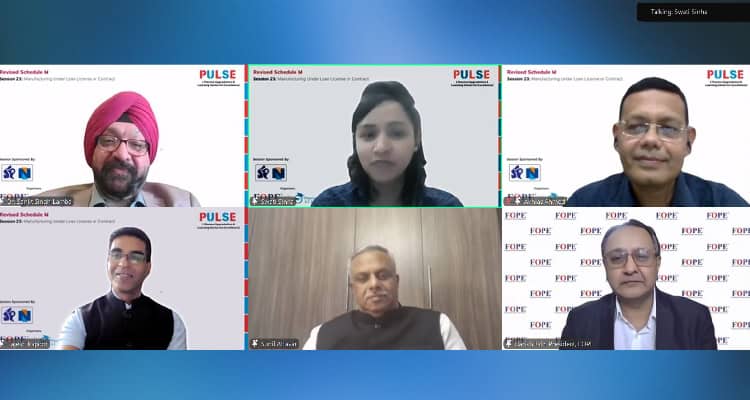

July 13, 2025, marked the successful completion of one year of the PULSE Program – Pharma Upgradation & Learning Series for Excellence – an initiative by FOPE (Federation of Pharma Entrepreneurs) and PharmaState Academy.
With Session 23 focusing on “Manufacturing under Loan License or Contract in light of the Revised Schedule M Guidelines”, the series continues to empower MSMEs with practical insights, regulatory clarity, and shared learning.
Session Highlights:
The event began with a keynote address by Sunil Attavar, Chairman of Group Pharmaceuticals. In his address, he emphasised that compliance should not be seen as the final goal but rather as the first step on the path to achieving real quality. He illustrated this point with the example of W. Edwards Deming and the Ford Motor Company, showing how Japanese manufacturers—despite working with the same specifications—produced better products due to tighter control and a strong focus on quality.
He warned that depending only on minimum compliance standards can lead to problems over time, as regulatory expectations keep changing. He stressed the need for a single, unified quality system across the company, no matter the size or type of client, to avoid confusion and reduce risks.
Attavar also highlighted the importance of strong product design, especially during development and validation, and encouraged meaningful employee involvement and real, continuous improvement, not just ticking boxes. He further pointed out that the cost of quality—including training, stability studies, and time from senior leaders—is a necessary and worthwhile investment. He concluded with the four key pillars of quality: customer focus, design, continuous improvement, and employee engagement, encouraging companies to treat quality as a core value, not just a requirement.
Expert Educator: The session was led by Dr Sanjit Singh Lamba, 35+ years of experience in Global Manufacturing, business operations, and regulatory compliance, Trillyum Consulting.
Dr Sanjit emphasised that contract manufacturing enables pharma companies to focus on marketing and development while leveraging the expertise of manufacturing partners. He highlighted that Schedule M (especially Clause 9) mandates detailed, regularly reviewed contracts, robust technology transfers, and proactive audits to ensure quality and compliance. Risk management, performance monitoring (complaints, yields, CAPAs), and awareness of change control were identified as critical. He noted frequent gaps in team understanding due to staff turnover and stressed the need for strong communication, confidentiality, and documentation practices. Dr. Sanjit called for better partner selection, talent retention, and investment in training and digital systems, urging management to follow “Gemba” principles—making decisions at the shop floor.
He also underlined the importance of safeguarding proprietary information and avoiding unauthorised process changes. Clear roles, audit trails, and individual access controls in computerised systems were recommended to uphold data integrity. Emphasis was placed on treating contracts as living documents and aligning all operational actions with documented expectations.
Panel Discussion: The session’s panel discussion, moderated by Harish Jain, President, FOPE, Director, Embiotic Laboratories, featured the following industry experts:
- Dr Sanjit Singh Lamba, Managing Partner, Trillyum Consulting and a pharmaceutical veteran with over 35 years of experience
- Akhlas Ahmed, Head – Supply Chain and New Developments, Mankind Pharma
- Rajesh Kapoor, 25+ Yrs in cGMP & Compliance, Pharma Compliance Expert, Regulatory Trainer
Engaging Q&A Session with Panellists: The panel addressed a wide range of practical challenges in contract manufacturing, beginning with audit frequency—emphasising that it should be risk-based and aligned with the criticality of the product and services involved. Panellists clarified that while separate storage areas for loan license and P2P raw materials are not mandatory, clear demarcation and documentation are essential for traceability.
On the subject of exclusivity, it was highlighted that agreements must clearly define ownership, licensing rights, and obligations, as there are no fixed regulatory rules governing exclusivity. The discussion also covered regulatory audits for cross-border manufacturing, where requirements depend on local laws but generally include plant registration and coordinated compliance with distributors and quality teams.
Regarding pharmacovigilance (PV), panellists explained that while the primary responsibility lies with the contract giver or product owner, the contract acceptor is equally accountable for maintaining quality and data integrity. Agreements should clearly define each party’s roles in adverse event handling. It was also noted that PV outsourcing is emerging as a significant opportunity for pharma service providers.
On licensing models, the panel clarified that although loan licenses and P2P arrangements differ in structure, the regulatory responsibilities and liabilities are now nearly identical. Both the contract giver and acceptor are jointly accountable for GMP compliance. A key topic was the outdated NPPA conversion charges from 2012; panellists agreed that cost structures should now reflect current requirements related to GMP, EHS, training, validation, and documentation. An open-book costing approach was recommended to ensure fair compensation, especially for MSMEs, and to avoid quality compromises that can damage brand reputation.
In matters of NSQ (Not of Standard Quality), responsibility is shared under the revised Schedule M, with liability depending on contract terms. While the contract giver holds the marketing authorisation, the manufacturer is responsible for execution and quality. Pharmacovigilance, though primarily the giver’s legal responsibility, requires active data generation and robust quality systems by the acceptor.
The importance of audit transparency was reinforced. While proprietary technologies may be protected via NDAs, overall quality systems, records, and processes must be fully auditable. Vendor qualification protocols, regular audit frequencies, and strong legal protections for intellectual property were all emphasised. A consistent standard of quality across all customers—regardless of company size—was advocated as non-negotiable.
To enhance global competitiveness, panellists urged companies, especially MSMEs, to pursue specialisation over volume-based manufacturing. On the topic of multi-location production, it was confirmed that manufacturing tablets in Plant A and packaging in Plant B is feasible. However, it requires careful contractual planning, validated hold-time studies, and attention to logistics and storage.
Addressing intellectual property concerns, panellists clarified that manufacturers cannot reuse the same formulation post-contract unless explicitly permitted by agreement. NDA clauses and non-compete provisions are essential to protect innovation and proprietary technologies. Finally, regarding the retesting of raw and packaging materials, it was stressed that companies must follow risk-based internal SOPs and defined retest periods, even if the manufacturer’s expiry date is longer.
The session concluded with a strong call for companies to build robust, risk-based quality systems, maintain transparency with partners, and focus on long-term value creation through compliance and collaboration.
Looking Ahead: The next session in the PULSE psorias is focusing on Management of Essential Contracts in Pharmaceutical manufacturing.