

PMEC India 2026 opens, puts spotlight on the next phase of pharma manufacturing
Dignitaries including Satyaprakash T L, IAS, Joint Secretary, Department of Pharmaceuticals, and Dr Raj Shirumala, Senior Scientific Advisor, Department of Pharmaceuticals, called for greater investment in advanced manufacturing, indigenous machinery, science and innovation, and a shift towards higher-value pharmaceuticals and next-generation biologics at the inauguration of the event

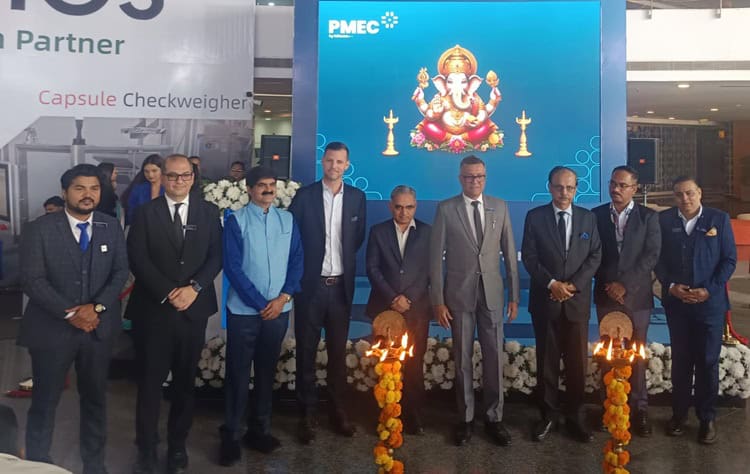

The next phase of pharmaceutical manufacturing will depend not just on production capacity, but also on access to advanced technologies, stronger domestic machinery capabilities and investments in modern manufacturing infrastructure. These themes were in focus as PMEC India 2026 opened at India Expo Mart Limited (IEML), Greater Noida, on November 24.
The 19th edition, being held from November 24–26, brings together pharmaceutical machinery manufacturers, technology providers, engineering companies and pharmaceutical producers to showcase equipment and technologies used in drug manufacturing.
This year’s edition follows a two-venue format, with CPHI India taking place from November 23–25 at IICC, Yashobhoomi, and PMEC India at IEML, Greater Noida. While CPHI focuses on pharmaceutical ingredients and formulations, PMEC covers machinery, equipment and manufacturing technologies. Together, the exhibitions feature over 2,000 exhibitors and are expected to attract 50,000 visitors from more than 120 countries.
Moving beyond volume-led manufacturing
The need to strengthen India’s manufacturing capabilities and move towards higher-value pharmaceutical production featured in the perspectives shared at the inauguration.
Satyaprakash T L, IAS, Joint Secretary, Department of Pharmaceuticals, highlighted the need for greater investment in advanced manufacturing technologies and indigenous machinery capabilities. He drew attention to how countries that have established technological leadership in other sectors have invested in science and innovation.
Dr Raj Shirumala, Senior Scientific Advisor, Department of Pharmaceuticals, Government of India, said India’s pharmaceutical industry needs to move beyond volume-driven growth towards higher-value innovation, including next-generation biologics and advanced pharmaceuticals.
Orhan Caglayan, Executive Vice President – Pharma, Informa Markets B.V., pointed to tariff pressures, margin compression and supply chain challenges as factors reshaping global pharmaceutical manufacturing. He also highlighted the growing role of automation, AI, digitalisation and sustainable production.
Yogesh Mudras, Managing Director, Informa Markets in India, said India’s pharmaceutical industry recorded an annual turnover of ₹5.08 lakh crore in FY2025–26, with average growth of 9.2 per cent over the preceding five years. Domestic medical device manufacturing expanded by approximately 48.2 per cent, from ₹28,000 crore in FY2019–20 to ₹41,500 crore in FY2024–25. He identified advanced biologics, specialised therapies and complex formulations as areas for future growth.
Cleanroom demand expands beyond pharma
This shift towards more complex manufacturing is also creating demand for specialised infrastructure, including cleanrooms. Demand is expanding beyond pharmaceuticals and biotechnology to sectors such as semiconductors, data centres, batteries and solar manufacturing.
India’s cleanroom market is valued at ₹25,000 crore, while non-pharma demand is projected to reach ₹6,000–7,000 crore within the next two years.
Reflecting these evolving requirements, PMEC India 2026 is showcasing processing and manufacturing machinery, filling and inspection systems, automated production lines, modular cleanroom infrastructure, HVAC systems, contamination-control technologies, packaging solutions and analytical laboratory equipment.
Technology, compliance and the next growth phase
The growing emphasis on advanced manufacturing is also bringing technology, quality and regulatory compliance into sharper focus. Stricter Good Manufacturing Practices (GMP), along with increasing interest in biologics and complex formulations, is driving demand for specialised machinery, automation and quality-control systems.
These developments also featured in discussions at the Pharma Connect Congress, which covered topics such as regulatory harmonisation, API supply chain resilience, AI-led R&D, Pharma 4.0, digital transformation and sustainable pharmaceutical packaging. Discussions also included biopharmaceutical manufacturing, technology transfer and external manufacturing partnerships.