

Panel Discussion: Beyond the needle: Innovations in painless drug delivery

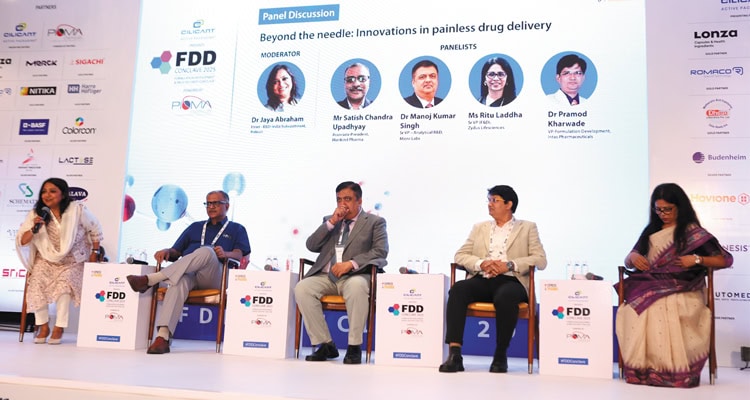

Drug delivery is undergoing a transformation driven by the demand for patient-friendly, painfree alternatives. As pharma R&D shifts toward improving compliance and therapeutic outcomes, an interesting panel discussion at FDD Conclave 2025 discussed the cutting-edge innovations in pain-less drug delivery methods and technologies.
As the moderator, Dr Jaya Abraham, Head – R&D-India Subcontinent, Haleon, led the panel. Panellists included Satish Chandra Upadhyay, Associate President, Mankind Pharma; Dr Manoj Kumar Singh, Sr VP – Analytical R&D, Micro Labs; Dr Ritu Laddha, Sr VP (F&D), Zydus Lifesciences; and Dr Pramod Kharwade, VP-Formulation Development, Intas Pharmaceuticals. The panellists began by discussing the advantages of painless drug delivery systems. Such methods are improving patient adherence, particularly in long-term therapies or chronic disease management.
The panel highlighted how such systems not only enhance patient comfort but also simplify administration, making them especially valuable for paediatric, geriatric, and needle-phobic populations.
The experts also discussed how nasal drug delivery offers significant promise due to its versatility and unique physiological advantages. It enables both local and systemic delivery. Additionally, nasal delivery reduces the risk of GI disturbances and enhances bioavailability for drugs that are poorly absorbed or degraded when taken orally. The panel also explored the emerging role of organ-on-chip technologies in the context of drug delivery.
By mimicking the structure and function of human organs on a microscale, organ-on-chip platforms can simulate how drugs behave in specific tissues, allowing researchers to optimise formulations and delivery methods without the need for invasive clinical trials. Though still in its early stages for direct drug delivery applications, the technology holds considerable promise in enabling more personalised and precise treatment strategies in the future.
Additionally, the panel emphasised that cross-disciplinary collaborations are essential to drive innovation in formulation and drug delivery. Partnerships can accelerate problem-solving and help translate laboratory breakthroughs into scalable, commercially viable solutions. While painless drug delivery systems offer clear benefits for patient adherence, they also present several formulation challenges.
Key among these are ensuring drug solubility, tolerability, and effective absorption through the skin or mucosal barriers. Unlike injectable routes that deliver drugs directly into the bloodstream, non-invasive systems must overcome the body’s natural protective layers. Success in these systems depends on designing drug molecules and corresponding formulations that can penetrate these barriers without compromising efficacy or causing irritation.
The panel stressed that achieving this balance is critical to unlocking the full therapeutic potential of painless delivery technologies. We live in a world increasingly driven by technology, and the pharma sector must harness these advancements to fuel innovation in drug delivery.
By embracing these innovations, the industry can create more effective, convenient, and personalised treatment options, ultimately improving patient outcomes and quality of life.