

Commerce Ministry highlights pharma export growth in Mumbai outreach
Government details 12-year reforms, rising exports, trade partnerships and roadmap for value-led expansion at Pharmexcil event

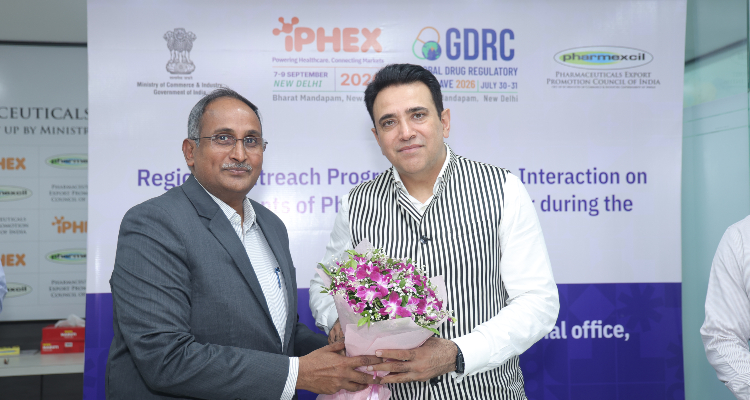

The Department of Commerce, Government of India, organised an outreach programme at the Regional Office of the Pharmaceuticals Export Promotion Council of India (Pharmexcil) in Mumbai to showcase the Department’s achievements, reforms and policy initiatives undertaken over the last 12 years.
The programme was attended by representatives from industry associations, including the Indian Drug Manufacturers’ Association, Indian Pharmaceutical Alliance and International Pharmaceutical Excipients Council of India. Representatives from companies including ACG, FDC Limited and other stakeholders also participated.
During an interaction with the media, Mohit Yadav highlighted India’s export growth, market diversification and trade relations with partner countries. He said the Government is working with industry to strengthen export capabilities, improve competitiveness and support the transition from volume-led exports to value-led exports.
Yadav stated that the Indian pharmaceutical sector has grown from about US$20 billion in 2014 to nearly US$60 billion in 2026 and is expected to reach US$130 billion by 2030. He added that pharmaceutical exports increased from US$14 billion in FY2015 to about US$31 billion in FY2026, registering a compound annual growth rate of 7.4 per cent, with an ambition to reach US$50 billion by 2030.
He said India remains the third-largest producer of pharmaceuticals by volume, supplies around 20 per cent of global generic medicines demand and exports pharmaceutical products to more than 200 countries. More than 60 per cent of India’s pharmaceutical exports are directed to regulated markets.
According to Yadav, India offers quality, continuity and affordability in healthcare supply chains. He pointed to around 1,000 US FDA-registered sites in India, the highest number outside the United States, as evidence of the country’s regulatory footprint. He also cited India’s ability to supply medicines during disruptions, including the pandemic and recent geopolitical developments.
The Joint Secretary noted that Maharashtra remains an important contributor to India’s pharmaceutical sector. He said Mumbai, Pune, Chhatrapati Sambhajinagar, Tarapur and nearby clusters have developed as centres for pharmaceutical manufacturing, research, exports and skilled talent. He added that Maharashtra’s pharmaceutical industry employs more than 200,000 people, including pharmacists, scientists and manufacturing workers.
Industry representatives acknowledged measures introduced by the Government to improve ease of doing business and strengthen the export ecosystem. These include digital issuance of Registration-cum-Membership Certificates, digital Certificates of Origin, the Trade Connect ePlatform, the Trade Infrastructure for Export Scheme portal, the Export Promotion Mission, research and development-linked support measures, and initiatives focused on quality, compliance and market access.
Yadav also highlighted Biopharma SHAKTI, or Strategy for Healthcare Advancement through Knowledge, Technology and Innovation. The initiative has been proposed with an outlay of ₹10,000 crore over five years and aims to position India as a global biopharmaceutical manufacturing hub. The programme seeks to support domestic production of biologics and biosimilars, strengthen research and development, improve clinical trial infrastructure, promote collaboration among academia, research institutions and industry, and enhance India’s position in the global biologics supply chain.
He further stated that multinational pharmaceutical companies are increasingly establishing Global Capability Centres in India. These centres employ more than 100,000 professionals and have attracted investments exceeding US$1 billion. The centres support functions including analytics, clinical operations, regulatory science, pharmacovigilance, digital health and research.
The Joint Secretary said that India’s trade agreements with partners including the United Arab Emirates, Australia, United Kingdom, European Union, European Free Trade Association, Oman and New Zealand are expected to support market access, regulatory cooperation, investment partnerships and technology collaboration. He added that the India-EFTA Trade and Economic Partnership Agreement, supported by a commitment of US$100 billion in investment over 15 years, could create opportunities in life sciences, research, manufacturing and health technologies.
Looking ahead, Yadav said future growth will increasingly be driven by biosimilars, biologics, gene therapies, specialty medicines, vaccines, complex generics, contract manufacturing, medical devices and greater self-reliance in Active Pharmaceutical Ingredients (APIs) and Key Starting Materials (KSMs), while generics will continue to remain the foundation of the sector.
He reiterated that India brings scale, skill, science, standards and social commitment to global healthcare. He added that the Department of Commerce will continue to work with industry stakeholders to maximise the benefits of trade agreements, address regulatory and geopolitical challenges and support India’s ambition to become a global hub for pharmaceuticals, innovation and drug development.