

Panel Discussion: Topical and transdermal drug delivery: The rise of non-invasive therapies

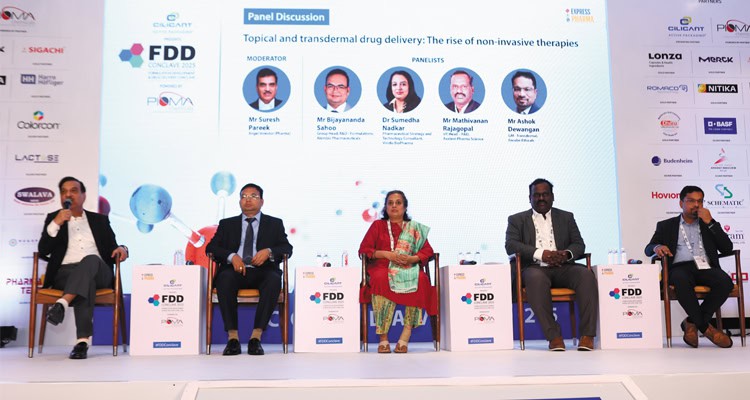

As the push for non-invasive, patient-centric treatment options intensifies, topical and transdermal drug delivery systems are gaining renewed attention. From dermatological treatments to systemic therapies, advances in formulation are expanding the scope and impact of these delivery platforms across therapeutic areas.
Addressing these points, our set of panellists delved into the science, technology, and commercial potential behind these routes of drug administration in the first panel at day two of the conclave.
Our esteemed panellists included Suresh Pareek, Angel Investor (Pharma), as the moderator; accompanied by Bijayananda Sahoo, Group Head, R&D – Formulations, Alembic Pharmaceuticals; Dr Sumedha Nadkar, Pharmaceutical Strategy and Technology Consultant; Ashok Dewangan, GM – Transdermal, Encube Ethicals; and Mathivanan Rajagopal, VP, Head – R&D, Axxlent Pharma Science. The panellists discussed the potential of topical and transdermal drug delivery systems in meeting the growing demand for non-invasive, patientfriendly treatment options.
They highlighted key benefits such as the ability to deliver drugs directly to a targeted local site, which can enhance therapeutic efficacy. Additionally, these systems offer controlled and sustained drug release, improving patient compliance and reducing dosing frequency. However, the panellists agree that, along with its benefits, such drug delivery systems do have their challenges.
For topical drug delivery, one of the first hurdles lies in selecting suitable drug candidates. While, repeated application of topical formulations may cause skin irritation or sensitisation, impacting patient adherence and limiting the longterm usability of such therapies. When it comes to transdermal patches, factors such as patch discomfort, detachment during daily activities, or visible placement on the skin can deter consistent usage, making patient adherence a significant challenge.
In the case of microneedle-based drug delivery, while the technology holds considerable promise for pain-free, minimally invasive administration, the panel acknowledged that commercial scalability remains a major hurdle. Manufacturing microneedles with the precision and consistency required for regulatory approval while keeping production cost-effective is a complex task that many developers are still working to overcome.
The discussion also brought attention to regulatory ambiguities, particularly for topical formulations. Unlike oral dosage forms, regulatory guidelines for topical drugs are not always clearly defined across markets. Establishing bioequivalence by demonstrating that a generic topical product performs similarly to its branded counterpart is one of the most critical and unresolved regulatory challenges. A less explored but highly promising area discussed by the panel was intranasal drug delivery.
The panel discussed that one of the most notable applications in this space is inhalable insulin, which has shown encouraging results in offering a non-invasive alternative to injectable insulin for diabetes management. Beyond systemic delivery, the panel also highlighted the exciting, yet still developing, potential of using the nasal route for direct drug delivery to the brain. This could open new therapeutic avenues for treating central nervous system (CNS) disorders such as Alzheimer’s.
However, challenges such as formulation stability, device design, and targeting efficiency continue to limit widespread adoption, making this a key area for future research and innovation. In conclusion, advances in formulation science and patch technologies are significantly expanding the possibilities for non-invasive drug delivery.