

The innovation litmus test
India has built the scientific capability to move beyond manufacturing. But as global pharma searches for its next innovation partners, the real test is whether India's ecosystem is predictable enough to inspire long-term confidence, writes Neha Aathavale


Every industry eventually reaches a point where yesterday’s biggest strength is no longer tomorrow’s biggest differentiator. For India’s pharma industry, that moment seems to have arrived. India’s manufacturing prowess has taken the country to the global stage. The next chapter, however, may rest less on what India can manufacture and more on what the world believes it can help create.
If recent conversations across the industry are any indication, it has already begun to take shape. The aspiration is no longer limited to manufacturing the world’s medicines, but to becoming a destination for innovation itself.
That ambition is also reflected in the EY Parthenon–Organisation of Pharmaceutical Producers of India (OPPI) report, Fueling innovation, advancing equity: The power of partnerships and digital-first strategies driving Indian pharma’s global dominance. Where it states that India’s pharma industry is entering precisely this next phase: One that calls for a transition from a cost-driven model to one anchored in innovation and value creation.
However, it also makes an important distinction. Innovation partnerships are rarely won on manufacturing scale, cost or capacity alone. Drawing on insights from industry CXOs, the report notes that attracting early-stage research and co-development programmes will increasingly depend on regulatory agility, intellectual property protection, sustained R&D investment and talent development.
It captures this shift in a single line: ‘Partnerships follow predictability.’ In other words, the question is no longer simply whether India can innovate, but whether its ecosystem offers the certainty global innovators seek before placing their next big bet.
That naturally leads to the next question. Has India already begun building the kind of ecosystem that inspires that confidence?
After the ‘Pharmacy of the World’
India’s appeal today stems from more than its manufacturing credentials. Over the past decade, the country has strengthened the building blocks that global innovators look for. Investments in R&D infrastructure, scientific talent, specialised technology platforms and integrated development capabilities have gradually expanded India’s role from an execution partner to a development partner. As global pharma companies increasingly look for collaborators who can contribute across the product lifecycle rather than simply manufacture at the end of it, India’s proposition has evolved accordingly.
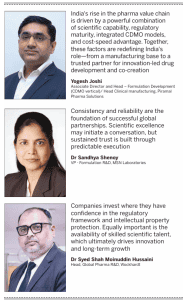
Validating this shift, Yogesh Joshi, Associate Director and Head – Formulation Development (CDMO vertical)/Head Clinical manufacturing, Piramal Pharma Solutions says, “Over the past decade, India has undergone a significant transformation—from being a cost-driven manufacturing hub to emerging as a credible and strategic partner for innovation and co-development in the global pharma landscape.” He also highlights that Indian CDMOs have moved well beyond traditional generics manufacturing and are now supporting early-stage development, new chemical entities (NCEs), complex formulations and lifecycle management, signalling a broader shift from execution-focused services to innovation-led collaboration.
Joshi further attributes this evolution to sustained investments in R&D, advanced technology platforms and integrated CDMO capabilities spanning pre-formulation, development, clinical manufacturing and commercial supply.
Dr Sandhya Shenoy, VP – Formulation R&D, MSN Laboratories, believes this transition has also been driven by stronger scientific capabilities. “Global pharma companies are increasingly seeking agile, scientifically capable partners who can contribute meaningfully throughout the development journey. India’s unique combination of scientific expertise, operational agility, speed, and scale has positioned it as a preferred destination for co-development and innovation-led partnerships rather than purely transactional outsourcing relationships.”
Echoing a similar view, Dr Syed Shah Moinuddin Hussaini, Head, Global Pharma R&D, Wockhardt, adds, “India has developed strong R&D capabilities over the last two decades while serving regulated markets across the world. Today, many Indian companies have experienced scientists, modern R&D infrastructure, and expertise in complex product development. As a result, global companies are increasingly seeing India not just as a manufacturing destination but also as a capable development and innovation partner.”
The global checklist
Yet, becoming an attractive innovation destination is only half the equation. Innovation partnerships are rarely won on a single strength. Instead, global pharma companies evaluate potential partners against a checklist of capabilities. Scientific expertise, regulatory maturity, quality systems, intellectual property protection, execution excellence and talent all carry weight. The question is not whether a country excels in one area, but whether it inspires enough confidence across all of them to become a long-term innovation partner.
According to Joshi, that evaluation begins with a partner’s ability to solve complex scientific problems while delivering consistently at a global standard. He states organisations look for expertise in complex products and advanced drug delivery systems, supported by robust quality systems, data integrity and a proven regulatory track record across pathways such as IND, NDA, ANDA and 505(b)(2). Beyond scientific capability, he highlights integrated end-to-end CDMO services, seamless technology transfer, reliable supply chains, project management and execution excellence as factors that increasingly influence partnership decisions.
Shenoy on the other hand believes scientific capability alone is only one part of the equation. “Organisations seek partners with strong capabilities in formulation science, process understanding, and advanced technology platforms. Equally important is an innovation-oriented mindset— the ability to solve complex technical challenges, generate scientific insights, and contribute to critical development decisions.” She further points out that robust intellectual property management, governance frameworks, execution excellence and proactive regulatory compliance are equally critical to building long-term confidence.
Summing up the industry’s priorities, Dr Moinuddin Hussaini says, “The most important factors are scientific talent, quality of R&D infrastructure, regulatory environment, IP protection, and the ability to consistently deliver high-quality outcomes. Cost remains important, but today companies are looking for capable partners who can contribute scientifically and accelerate development timelines.”
Taken together, these perspectives suggest that attracting innovation partnerships is no longer about competing on cost or manufacturing scale alone. Increasingly, it is about demonstrating that every box on global pharma’s checklist can be ticked, consistently and predictably.
Mind the gap
If India’s scientific capabilities have strengthened and global interest is growing, what still prevents it from capturing a larger share of innovation-led partnerships? The experts suggest the answer lies less in capability itself and more in the ecosystem surrounding it.
One challenge, they point out, is perception. Despite significant progress in research and development, India is still widely associated with generics and cost-efficient manufacturing. Dr Shenoy believes this perception no longer reflects reality. According to her, India’s scientific capabilities often exceed global perceptions because many organisations invest far more in programme delivery than in showcasing their scientific achievements through publications, patents, conference presentations and thought leadership.
At the same time, Joshi believes deeper structural gaps remain. While India has made significant strides, he notes that fewer companies are engaged in early research, new drug development and advanced technologies than their global counterparts. He also points to limited capabilities in areas such as biologics, gene therapies and complex drug device combinations, alongside the need for greater consistency in quality, regulatory readiness and specialised scientific expertise. Joshi adds that stronger collaboration between academia, startups and industry, coupled with better research infrastructure, will be essential if India is to move beyond its image as a manufacturing destination and establish itself as an innovation leader.
For Dr Moinuddin Hussaini, the ecosystem itself holds the key. “They are extremely important. Companies invest where they have confidence in the regulatory framework and intellectual property protection. Equally important is the availability of skilled scientific talent, which ultimately drives innovation and long-term growth.” He believes stronger collaboration between academia, research institutes, startups and industry could have the single biggest impact on India’s ability to become a preferred global innovation partner.
Ultimately, India’s next challenge may not be proving that it can innovate. It is ensuring that its policies, institutions and collaborations evolve at the same pace as its scientific ambitions. Because if partnerships follow predictability, predictability is built long before the partnership begins.
The final mile
If there is one thread running through the industry’s vision for the future, it is that capability alone will not secure India’s place in the next phase of pharma innovation. Sustaining that momentum will require an ecosystem that evolves as quickly as the science itself.
The EY Parthenon– OPPI report outlines three priorities to accelerate this transition. The first is regulatory agility, including aligning Indian GMP standards with global benchmarks, creating a dedicated regulatory pathway for CRDMOs and strengthening Regulatory Data Protection (RDP) to encourage early-stage research and co-development. The second is greater investment in innovation through public-private funding, higher industry spending on R&D and stronger collaboration between academia, startups and pharmaceutical companies. Finally, the report calls for a renewed focus on talent, urging academia and industry to work together to build capabilities in areas such as artificial intelligence, bioinformatics and regulatory science while linking research more closely to commercial outcomes.
Dr Shenoy believes Indian R&D teams must also deepen their scientific capabilities to remain competitive. According to her, future programmes will increasingly demand mechanistic understanding, digital and data-driven development, and closer collaboration between formulation scientists, engineers, data scientists, regulatory specialists and clinical teams. She adds that building a stronger culture of scientific curiosity, publications, patents and global thought leadership will be equally important in positioning India as an innovation led ecosystem.
The direction, therefore, is becoming increasingly clear. India’s manufacturing success created the foundation. Its scientific capabilities have strengthened the proposition. The next phase will depend on how effectively industry, academia and policymakers can work together to build an ecosystem that global innovators do not just recognise, but repeatedly choose.
[email protected]
[email protected]
