For decades, globalisation has shaped supply chains around a single organising principle: produce where it is cheapest and most efficient, and move goods across borders at scale. But in an increasingly fractured world marked by geopolitical tensions, trade restrictions and policy-driven realignments, that logic is quietly being reworked. Supply chains are no longer evaluated solely on cost and capacity, but increasingly on trust, reliability and political alignment.
Friendshoring is gaining momentum, and the pharma industry is no exception. However, the question is whether it is emerging as a targeted risk management exercise or it represents a permanent shift away from global supply networks. Equally important is how India is being positioned within this framework by industry stakeholders.
Kaifeel Shaikh Vice President – Domestic Distribution & Global Logistics–EXIM, Indoco Remedies
“The pharma industry is undergoing a fundamental strategic re-structuring”
Setting the context
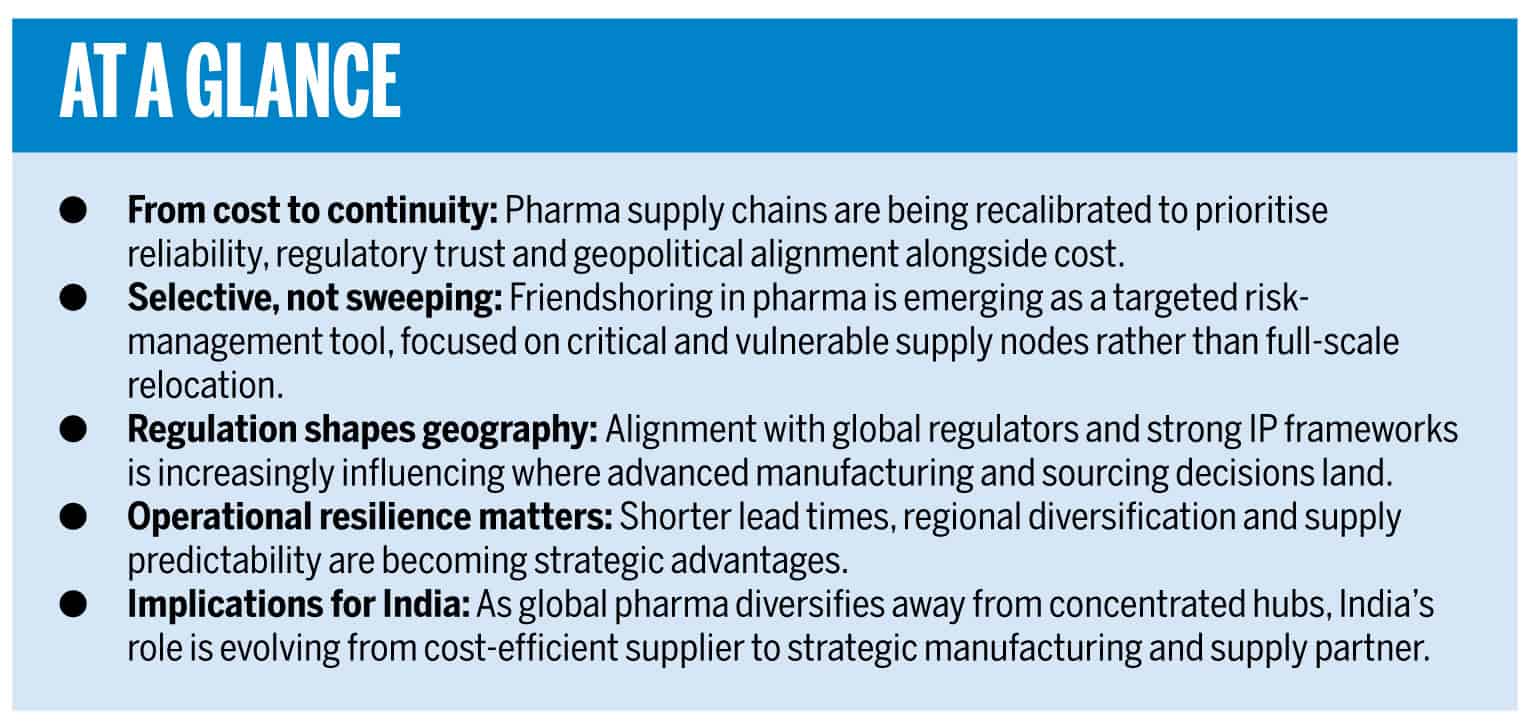
Friendshoring has moved from a conceptual strategy to an actionable consideration for pharma companies as they reassess vulnerabilities in their supply chains. Supply chains are no longer evaluated solely on cost efficiency; they have direct implications for patient access, regulatory compliance, and operational resilience.
Nihar Medh, Global Head of Supply Chain at Piramal Pharma, says the pandemic and geopolitical pressures “exposed the fragility of highly concentrated sourcing models, particularly for critical APIs and key starting materials.” He adds that today, “supply continuity, resilience, and predictability carry equal weight alongside cost efficiency,” highlighting how risk management has become as important as cost considerations.
However, rather than signalling a complete withdrawal from global networks, friendshoring is being adopted as a targeted approach. Companies are identifying these vulnerable points and diversifying selectively. As Shrikant Gade, Sr VP Procurement, FDC notes, “Most pharma companies are not wholesale relocating entire supply chains in the short term, given capital intensity, regulatory complexity and established global networks. Instead, friendshoring is being adopted selectively—often focusing on high-risk nodes such as API production, critical packaging materials, or essential drug manufacturing where geopolitical risk or supply fragility is greatest.” In practice, this means focusing on areas of critical risk while maintaining the advantages of global efficiencies elsewhere
Regulatory alignment has also emerged as a major factor in choosing trusted geographies. Kaifeel Shaikh, VP – Domestic Distribution & Global Logistics–EXIM, Indoco Remedies points out that companies are prioritising countries with strong IP protections and harmonised regulatory standards. He explains, “Aligning R&D and advanced manufacturing with friendly nations with strong, enforceable IP laws is a major priority. Sourcing from countries with regulatory standards harmonised with the FDA, EMA, or PMDA drastically reduces compliance risk and accelerates time-to-market.” Regulatory trust has become central to decisions about where critical production occurs, rather than a background consideration.
Operational efficiency and responsiveness are also driving friendshoring. Diversified regional supply chains can shorten lead times, improve responsiveness to demand shifts, and reduce logistical risks. Medh observes, “Regionally diversified supply chains improve lead times, increase responsiveness to demand shifts, and enable more efficient inventory and logistics management, while also reducing the environmental impact associated with long distance transportation.” By spreading operations across reliable geographies, companies are building resilience without abandoning the advantages of global production networks.
Geopolitical tensions and trade disruptions continue to reinforce these shifts. Neeraj Bansal, Partner and Head, India Global, KPMG in India, reiterates, “recent survey estimates show that pharma supply chain challenges will remain the most impactful industry trend over the next 12 months. This shift has been accelerated by a fresh wave of geopolitical disruptions, export controls and now even tariffs and trade restrictions, which are directly disrupting supply chains.”
Shrikant Gade Senior Vice – President Procurement, FDC Limited
“Adoption today tends to be strategic and targeted rather than sweeping, with companies integrating friendshoring principles as part of broader diversification, regionalisation and risk mitigation efforts.”
Pharma’s special case
While friendshoring strategy is gaining momentum, it also comes with its distinct set of challenges. With pharma supply chains being tightly regulated, and highly specialised. Disruptions are not just operational, they can affect access to essential medicines.
The sector’s complexity makes selective risk management essential. Shaikh highlights that pharma supply chains are time-sensitive and intricate, with many critical components concentrated in a few regions. He notes that the areas of highest concern include “Active pharmaceutical ingredients (APIs) and key starting materials, sterile injectables, biologics, monoclonal antibodies, vaccines, cell and gene therapy, and certain specialty raw materials and intermediates.” These nodes are particularly vulnerable because production capacity is limited and alternatives are scarce.
Beyond manufacturing complexity, regulatory compliance and quality standards play a decisive role in sourcing decisions. Gade points out that global clients are increasingly evaluating geographies based on regulatory compliance, legal reliability, IP protection, governance transparency, data access, and geopolitical alignment. In pharma, even minor lapses in regulatory adherence can have outsized consequences, making trusted geographies non-negotiable for critical products.
Operational factors add another layer of nuance. Medh explains that regionally diversified supply chains help companies “improve lead times, increase responsiveness to demand shifts, and enable more efficient inventory and logistics management,” while also mitigating environmental impact. However, advanced intermediates, complex chemistries, and high-complexity manufacturing often remain globally integrated, as companies continue to rely on established hubs where expertise, scale, and ecosystem maturity are concentrated.
The high stakes also extend to data integrity and intellectual property protection, particularly for biologics and novel therapies. Shaikh underscores that aligning R&D and manufacturing with nations that uphold strong IP laws is critical. Clients expect geographies where IP is respected and data access is secure, ensuring that innovation and quality are safeguarded throughout the supply chain.
Taken together, these factors explain why pharma companies approach friendshoring with caution. It is not about replacing global networks but selectively enhancing resilience where risk is highest.
This selective approach raises the question of how companies define the geographies they can rely on most. Understanding what makes a country “trusted” sheds light on India’s evolving role in global pharma supply chains.
What makes a geography ‘trusted’
As pharma companies evaluate friendshoring strategies, the concept of trusted geographies has become central to decision-making. For global clients, trust is multi-dimensional, encompassing regulatory compliance, intellectual property protection, operational transparency, data integrity, and geopolitical alignment. Medh explains, “Trusted geographies combine regulatory rigor, governance discipline, data transparency, and geopolitical stability to support dependable, long-term pharmaceutical supply partnerships.”
Regulatory alignment is often the starting point. Countries with consistent inspection outcomes, harmonised standards with global regulators, and a robust compliance culture are considered more reliable. Shaikh notes that aligning R&D and manufacturing with nations that have strong, enforceable IP laws and regulatory standards “drastically reduces compliance risk and accelerates time-to-market.” This ensures that critical production remains uninterrupted while meeting global quality expectations.
Geopolitical stability and predictability are equally critical. Companies increasingly avoid sourcing from regions where political tensions or trade restrictions could threaten supply continuity. Gade observes that clients consider not only regulatory and operational reliability but also “alignment with US, EU, and Japan-led trade and sanctions regimes” and a low probability of forced supply redirection during crises. These considerations underpin strategies such as dual sourcing and China+1 diversification.
India’s role in this landscape has grown beyond being a fallback option. Medh points out that the country is “increasingly being viewed as a long-term strategic partner rather than only a China+1 alternative,” thanks to its depth in chemistry, manufacturing capabilities, regulatory experience, and scale of execution. Shaikh adds that India’s policies, robust pharma infrastructure, and high number of US FDA-approved plants signal reliability to global clients.
From a market perspective, Bansal notes that this shift has created expanded opportunities for Indian manufacturers. He observes, “The EU and the UAE are actively strengthening pharma supply chains and increasingly engaging India as a trusted partner, creating expanded opportunities for Indian API and formulation manufacturers.” At the same time, India’s dependence on imported APIs, particularly from China, underscores the need for ongoing domestic capacity building to mitigate risks and solidify its strategic position
In effect, India is transitioning from a tactical diversification option into a critical node in global pharma supply chains. Companies are leveraging its regulatory maturity, skilled workforce, and manufacturing scale to anchor essential production while retaining flexibility elsewhere. Trusted geographies like India allow pharma companies to combine resilience, compliance, and speed in a world where geopolitical and trade uncertainties are increasingly shaping strategic sourcing decisions.
Nihar Medh Global Head of Supply Chain, Piramal Pharma
“India is increasingly being viewed as a long term strategic partner rather than only a China+1 alternative, even though diversification initially accelerated engagement”
Sensitive nodes
Even within trusted geographies, pharma companies are selective about which parts of their supply chains are friendshored. The focus is on nodes where disruption could have the most immediate impact on patient access, regulatory compliance, or operational continuity. Medh explains, “Client concern is sharpest where disruption directly threatens access and patient outreach. APIs and key starting materials remain the most sensitive, especially where supply is geographically concentrated or alternatives are limited.”
Sterile injectables, critical for hospital medicines and vaccines, are another priority, alongside complex biologics and biosimilars. Shaikh highlights that “monoclonal antibodies, vaccines, cell and gene therapy, and certain specialty raw materials and intermediates” are high-risk areas due to capacity scarcity and chemical complexity. Cold-chain logistics also remain a vulnerability, given the dependence on specialised providers and cross-border transport.
At the same time, not all parts of the pharma supply chain are being regionalised. Finished dosage manufacturing for small molecules, earlystage R&D, and non-critical raw materials often continue to rely on globally integrated networks.
Operational and economic considerations influence this balance. Companies weigh the benefits of resilience against scale, cost, and capability depth. Medh points out that friendshoring “is a targeted strategy focused on critical vulnerabilities, balancing resilience with scale, capability depth, and economics.” In practice, this means that while critical APIs, sterile injectables, and advanced intermediates are being regionalised or dual-sourced, other components and manufacturing processes continue to leverage established global hubs where expertise and ecosystem maturity are concentrated.
This selective approach sets the stage for understanding what capabilities global clients now expect from Indian CDMOs, including scalable capacity, regulatory readiness, data security, and speed, which will define India’s strategic role in friendshoring supply chains.
Neeraj Bansal Partner & Head, India Global, KPMG India
“Tariff and trade uncertainty is already prompting companies to change their production plans and explore new contracts to relocate manufacturing.”
CDMO test
With selective friendshoring targeting high-risk nodes, global pharma companies are increasingly focused on the capabilities of contract development and manufacturing organisations (CDMOs) in trusted geographies. Indian CDMOs, in particular, are under spotlight for their ability to deliver resilience, regulatory compliance, and operational agility across complex supply chains.
Medh notes that clients are seeking CDMOs that can combine multiple capabilities: “In the wake of the Biosecure Act, clients are asking Indian CDMOs to strengthen capabilities in a balanced way. Capacity scale still matters, but with an emphasis on flexible and modular capacity that can adapt quickly without quality trade offs.”
“Regulatory readiness remains fundamental, with expectations of constant inspection readiness, strong quality systems, and confidence across multiple regulatory regimes. Data security and digital maturity are rising priorities, covering data integrity, cybersecurity, and controlled transparency,” he adds.
In essence, the expectation is for CDMOs to deliver scale with agility, compliance with confidence, and speed with discipline.
These requirements align with the broader trend of riskaware global sourcing. Indian CDMOs benefit from the country’s established regulatory infrastructure, skilled workforce, and proven track record in high-volume and complex manufacturing, which collectively support these client expectations.
At the same time, geopolitical and trade uncertainties continue to influence planning. Bansal states that “tariff and trade uncertainty is already prompting companies to change their production plans and explore new contracts to relocate manufacturing. CDMOs are reevaluating reliance on China and increasingly turning to nearshoring and friendshoring for supply chain security.” This is creating opportunities for Indian manufacturers, particularly in APIs, essential drugs, and shortage-prone categories, as companies look to diversify and secure supply from reliable partners.
India’s positioning is evolving from a diversification option to a long-term strategic partner. As Medh points out, “Global clients see India as a dependable base for high-quality APIs, intermediates, and finished dosages, backed by a strong regulatory track record, skilled talent, and proven global delivery.” Government incentives, such as production-linked schemes, and the country’s growing capabilities in complex biologics and advanced therapies further strengthen this narrative.
For Indian CDMOs, the challenge is balancing capacity expansion, regulatory readiness, and technology upgrades with speed and flexibility. Companies that can meet these multidimensional requirements are positioned not only to serve existing markets but also to anchor new supply chain hubs as global pharma navigates friendshoring strategies.
India’s path forward
Selective friendshoring is reshaping how global pharma views investment, policy, and strategic partnerships. Companies are increasingly prioritising reliability, regulatory alignment, and political predictability over purely costdriven decisions. As Bansal observes, recent geopolitical disruptions and trade restrictions “have exposed critical vulnerabilities in global drug supply chains, including overdependence on concentrated production hubs and the risk of shortages.”
For India, this creates opportunities to strengthen its role beyond being a shortterm China+1 alternative. The country is recognised for its manufacturing depth, regulatory track record, and skilled workforce, making it an attractive partner for high-quality APIs, intermediates, and finished dosages. Indian CDMOs, in particular, are expected to meet multidimensional demands; scalable production, regulatory readiness, and operational flexibility, positioning them as strategic anchors in global supply networks.
At the same time, India’s reliance on imports for nearly 70 per cent of its APIs highlights a critical vulnerability. Bansal notes that reducing this dependency and expanding domestic API capacity will be essential for securing both domestic supply and export commitments. Policy incentives, private sector investment, and innovation-led initiatives will play a decisive role in consolidating India’s position.
Beyond traditional US and China linkages, global companies are increasingly looking to Western Europe, Japan, Korea, Singapore, and parts of North America to build diversified supply chains. This opens avenues for India to deepen collaborations while helping create a more balanced and resilient pharma ecosystem.
In a world where trust, compliance, and capability now define supply chain partnerships, India’s challenge will be to translate its scale and regulatory strength into a permanent, long-term strategic role. Building domestic capacity, fostering innovation, and strengthening public-private collaboration will determine whether the country becomes a cornerstone of friendshored pharma supply chains or remains primarily a diversification fallback.