

India to build future-ready drug regulatory framework to accelerate healthcare innovation, Says J P Nadda
CDSCO to roll out an end-to-end digital regulatory platform within 18 months

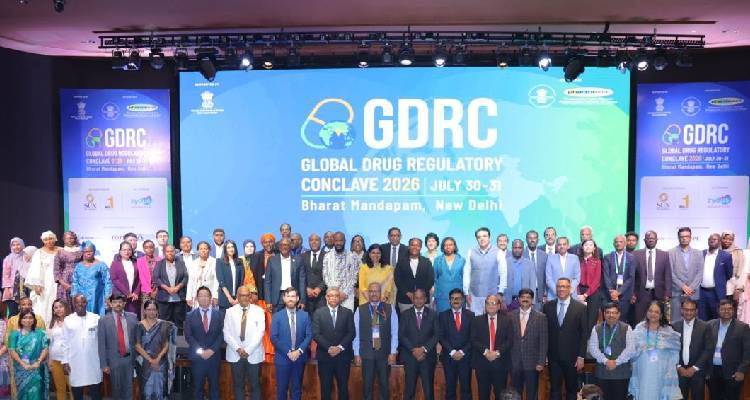

India is building a future-ready drug regulatory framework to accelerate healthcare innovation while maintaining the highest standards of patient safety, quality, and efficacy, Union Minister for Health and Family Welfare J P Nadda said in his virtual address at the inaugural Global Drug Regulatory Conclave (GDRC) 2026.
Reinforcing this vision, Drugs Controller General of India (DCGI) Dr Rajeev Singh Raghuvanshi announced at the event that the Central Drugs Standard Control Organisation (CDSCO) will roll out the first phase of an end-to-end digital drug regulatory platform within the next 18 months, marking a significant step in modernising India’s pharmaceutical regulatory ecosystem.
Addressing regulators, policymakers, industry leaders, and delegates from across the globe, Nadda said India’s pharmaceutical industry is evolving from a global supplier of affordable generic medicines to a global center of pharmaceutical innovation. As healthcare advances towards biologics, biosimilars, gene therapies, precision medicine, AI-assisted drug development, and digital therapeutics, he said India’s regulatory framework must evolve in parallel to facilitate innovation while upholding uncompromising standards of safety, quality, and efficacy.
Highlighting the Government’s ongoing regulatory reforms, Nadda said CDSCO is undergoing a comprehensive transformation driven by transparency, scientific rigour, efficiency, accountability, and digital governance. He added that digital regulatory platforms, risk-based oversight, strengthened inspection systems, and enhanced surveillance are creating a modern regulatory ecosystem that inspires greater global confidence. Calling for deeper international collaboration, he urged regulators to strengthen information sharing, regulatory science partnerships, collaborative inspections, and the convergence of scientific standards to improve global access to safe, effective, and affordable medicines.
In his opening remarks at the event, Dr Rajeev Singh Raghuvanshi outlined CDSCO’s roadmap for regulatory transformation centered on digitalisation, innovation, quality assurance, and global regulatory convergence. He said the upcoming common digital regulatory platform will integrate the entire pharmaceutical regulatory value chain from research and clinical development to manufacturing, approvals, distribution, and post-market surveillance—bringing together central and state regulators, manufacturers, and other stakeholders into a single digital ecosystem.
Dr Raghuvanshi said more than 99 percent of CDSCO’s regulatory processes have already been digitised, significantly improving transparency and approval timelines. Building on this, CDSCO is piloting Artificial Intelligence across regulatory processes to create a faster, more agile, and data-driven regulatory system. He also announced that GMP and Certificate of Pharmaceutical Product (COPP) certificates will soon carry QR-code-based digital authentication, enabling overseas regulators to instantly verify their authenticity while reducing verification timelines.
Highlighting initiatives to strengthen quality and innovation, Dr Raghuvanshi said CDSCO has streamlined its export regulatory framework through a fully digitized export No Objection Certificate (NOC) system, introduced globally aligned regulatory reliance mechanisms, and accelerated approval pathways to enable faster patient access to innovative therapies. Around 25–30 percent of clinical trials are currently being considered for waiver for eligible innovative products. He further highlighted MedTech Mitra, which has already supported more than 800 startups in navigating regulatory pathways, and noted that similar facilitation mechanisms are planned for biologics and other emerging technologies.
Further, speaking at the event, Mohit Yadav, IFS, Joint Secretary, Department of Commerce, EP (Pharma), said, “For pharmaceuticals, regulation is the true border. Faster, transparent, and predictable pathways can improve patient access without lowering standards. India must build on the trust it has earned through quality manufacturing by deepening regulatory cooperation, reliance, and responsible use of digital and AI-enabled tools.”
Namit Joshi, Chairman, Pharmexcil, said, “India has earned its position as the pharmacy of the world, and the next step is to become a stronger regulatory partner. As global expectations on quality and compliance continue to evolve, GDRC will bring regulators and industry together to promote harmonised standards, clearer regulatory pathways, and faster access to quality, affordable medicines. It will also help translate policy into consistent compliance across the industry, strengthening confidence in Indian pharmaceuticals across global markets.”
The Global Drug Regulatory Conclave 2026, organized by the Central Drugs Standard Control Organization (CDSCO) in association with Pharmexcil, brought together global drug regulatory authorities, policymakers, researchers, industry leaders, and international organizations to deliberate on the future of pharmaceutical regulation. The conclave focused on strengthening regulatory cooperation, advancing digital transformation, promoting regulatory science, encouraging innovation, and building resilient global healthcare supply chains that ensure timely access to safe, effective, and affordable medicines.