

Made in India – The story of Desh Bandhu Gupta, Lupin and Indian Pharma
The book shares how an individual’s life, shaped early by adversity, growing up without privilege or patronage, unpredictably nurtured hunger and drive, to navigate an unforgiving state, blend national health priorities and global standards, to build a multibillion-dollar enterprise whose medicines reach patients in over 120 countries.

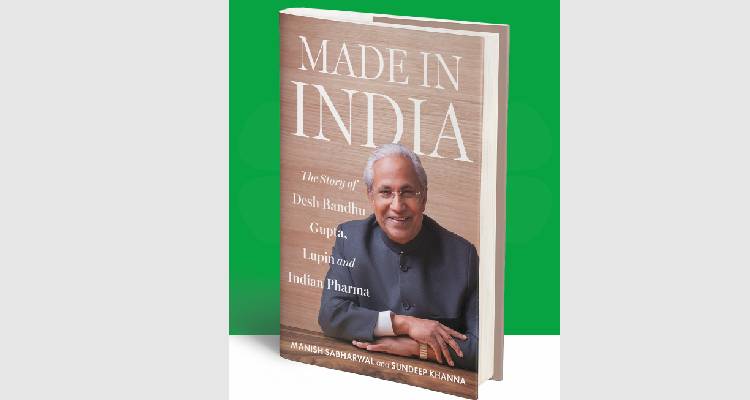

Made in India, written by Sundeep Khanna and Manish Sabharwal, traces three remarkable journeys: the rise of India’s pharma industry, the birth and evolution of Lupin and the extraordinary life of its founder, Desh Bandhu Gupta. Together, the three journeys illuminate how a country once completely dependent on imported medicines became the world’s pharmacy.
Made in India shows the distance travelled by a village boy from Rajasthan, who went on to become a teacher, professor and pharmaceutical employee, before founding a company worth $10 billion. It is the story of how an unlikely entrepreneur, given his role models, fought the system and left teaching and pharma jobs, going on to build a successful company, giving wings to a world-class industry and becoming a business icon for a nation.
Praise for the book:
Dilip Sanghvi of Sun Pharma said, “DBG was a visionary whose heart beat for India and for Indian patients. His relentless focus on excellence defined his personality. He was a remarkable role model for all of us and one of the true architects who helped shape India’s journey to becoming the pharmacy to the world”.
Yusuf Hamied of Cipla said, “DBG built Lupin from extremely modest beginnings, guided by determination and a deep commitment to serving patients. DBG’s life story is not only inspiring, but also a reminder of how one individuals purpose can make healthcare accessible and affordable across the world”.
Chapter 16 of the book:
Governance and Leadership
The team you build is the company you build. -VINOD KHOSLA, Silicon Valley Investor
Amantramaksaras nasti, nasti mulamanausadham
Ayogyah puruso nasti, yojakastatra durlabhah.
(There is no letter / script that cannot be a mantra, there is no root which doesn’t have medicinal properties. There is no person who is not worthy, but rare is the one who can bring all together.) – MAHA SUBHASHITA SAMGRAHA
Movie-maker Steven Spielberg could have been talking about entrepreneurship when he said, ‘Directing is 90 per cent casting’. The crisis had convinced DBG that he needed a chief executive whom he could trust, empower and hold accountable to execute his vision, complement his capabilities and free up his bandwidth. He was not ready to retire but did need to decide whether to designate one of his children as CEO or get an outsider.
Creating a successful company is a team sport where an entrepreneur’s superpower lies in matching team members’ skills to the jobs at hand. However, building a successful and large company requires effective governance transitions and a diverse range of skills. Individual geniuses like Steve Jobs, who hope to `make a dent in the universe’, need to be complemented with talented people who have the skills to work in groups, respect processes and not baulk at the inevitable institutionalization and bureaucracy that comes with scale. This superpower is what academic Warren Bennis called `organizing genius’. Finding a framework that aligns talent within an integrated framework of purpose, governance, culture, leadership, structure and execution is more art than science. It is also learned by doing. DBG’s reflections on Lupin’s near-death experience following the financial crisis had sharpened his thinking about balance and the right human capital configuration to deliver on the company’s promises and potential.
DBG considered handing over running the company to Vinita and Nilesh but hesitated. Vinita’s move to the US had greatly improved the company’s US business, though the real success of Lupin’s generics was still a few years away. Nilesh had just graduated from business school. Happy with their progress and potential, DBG decided they must each demonstrate performance before they could be ‘spiritually’ acceptable to his experienced, loyal and tenured team as chief executives. He had also not decided whether to designate one of the two as his successor or give them joint responsibility.
Like most entrepreneurs, his thinking about Lupin’s board of directors had evolved over the company’s lifecycle since it started in 1968. For the first decade, Lupin’s board consisted only of immediate family members: his wife, father-in-law and himself. Later, some of the brothers and advisors joined, but primarily to meet legal requirements. A significant shift occurred when the company went public in 1993; independent board members were appointed. However, even in the years following the IPO, DBG viewed the board’s role as ensuring regulatory compliance, approving business plans as presented and supporting management decisions. Surprisingly, the view also prevails in many larger global companies. During Jack Welch’s tenure at General Electric, when a new board member asked an existing board member what their role entailed, he received the unforgettable response of ‘applause’.
To be effective, a board of directors must strike a delicate balance – too much interference hampers management’s ability to operate effectively, while too little engagement undermines the board’s role as both overseer and strategic sounding board. The difficulty in finding this balance is captured by the military aphorism: `Any army with a big gap between its thinkers and doers will have its fighting done by fools and its thinking done by cowards.’ DBG valued his autonomy but could not help wondering: Would a stronger board have prevented the company from incurring the big losses from investing in the stock market and real estate? He was thinking in the right direction. Research suggests that the most dangerous lies are the ones we tell ourselves, both as individuals and as groups. The best way to protect ourselves from our worst instincts is by surrounding ourselves with people who serve as hearing aids, seat belts and mirrors. Cognitive diversity in teams is a superpower: The legendary emperor Krishnadevaraya had all his official buildings inlaid with carvings of a procession of tigers, elephants and horses to remind his team that every great government is a combination of courage (tigers), stability (elephants) and speed (horses).
The quality of Lupin’s board, its role and independence changed substantially over the next two decades. Gradually, trusted advisors who had retired from the bureaucracy, banking or auditing joined family members on the board. The first change to this pool came from the two CVC nominees: Sunil Nair and his colleague Marc Desaedeleer. Both were voices for capital on behalf of minority shareholders and added considerable strategic value. Following them were well-known banker K.V. Kamath, former CEO of ICICI Bank, and bureaucrat-economist Vijay Kelkar, who had recently completed a stint as finance secretary in the GoI. Recent board members have included seasoned professionals such as the former CEOs of Asian Paints, Roche Diagnostics, Barr Labs, PDL Biopharma and Pfizer, and the former president, International, at Eli Lilly. This cognitive diversity at the top has been hugely beneficial to Lupin.
Unlike many founders who found the idea of bringing in an outside CEO challenging, DBG had already tried this model by bringing in Humayun Dhanrajgir as chief executive in 1993, but this had not been successful. His next choice of MD, however, was an inspired hybrid option: an insider who was currently outside. Kamal Sharma returned in 2003 as MD to work with the man he considered both a friend and an inspiration.
The two men got to work on a leadership revamp. Most of the senior team had left during the financial crisis. DBG acknowledged that some of his people choices had not been successful and that there had been insufficient intellectual diversity. The turbulence in top management bothered DBG; he believed stable leadership was crucial to success. His experiment with recruiting high-profile executives from outside, offering generous compensation packages, had assumed they would bring in best practices and show the way forward, but it had not always succeeded. Many of them, particularly those at the tail end of their careers, were more interested in feathering their own nest. What he needed was the hunger and drive of the powerful new team he soon built.
DBG’s style made him more akin to the authoritative leader that psychologist Daniel Goleman describes in his work on emotional intelligence and leadership as one who `mobilizes people toward a vision’ but gives them freedom regarding the means. Once he had established the overarching goals and strategic framework, he gave considerable autonomy to leaders like Kamal Sharma to determine the implementation specifics. According to Goleman, this leadership approach creates a powerful dynamic in which the leader maintains control of the core vision while empowering the team to find creative ways to overcome obstacles.
Sharma was a key ally. His immediate task was to assemble a top-quality team. His presence fostered trust within the professional community, and he soon brought in finance and HR heads from reputable multinationals. His key responsibilities were organizational transformation, talent management and preparing the organization for the challenges of the next growth phase. DBG gave him a free hand, regularly reminding him to maintain high standards. Responding to the HR head’s announcement that IIM Ahmedabad had been contracted to take Lupin’s managers through a development programme, he said, ‘I know you’re visiting America next month; please visit Harvard and Stanford and get them to customize some programmes for Lupin.’ Lupin’s people practices soon became state-of-the-art, earning it recognition as a leading employer in industry surveys.
Changing Lupin’s culture was harder and took longer. The culture of hustling, informality and personal relationships that had delivered results during the start-up and growth decades took a beating during Lupin’s financial crisis, which began in 1993. The decade-long financial crisis led to a complete overhaul of leadership, resulting in the loss of institutional memory and continuity. DBG used this time to think about Lupin’s purpose and formalized core values that could guide the thousands of Lupin employees, many of whom he would no longer meet or know personally. After much debate, Lupin’s core values were identified as : integrity, passion for excellence, teamwork, entrepreneurial spirit, respect and care, and customer focus. He also decided that the company’s prosperity should be shared more widely and, in 2005,introduced one of the first employee stock option programmes (ESOPs) in the pharma sector. Five years later, the programme was expanded to cover many more employees. DBG insisted on eventually extending the ESOPs to all employees in the company. Employees, decades later, would talk about how the ESOPs they were issued helped fund their children’s education, marriages and even houses.
As the company scaled up, DBG was concerned about ensuring that Lupin never became the dreaded impersonal corporation populated by hyenas (who eat what others hunt and kill) rather than tigers (who eat only what they hunt and kill). Large companies require bureaucracy and processes to operate effectively, but these often lead to a lack of accountability for performance. Alibis such as `above my pay grade’ (AMPG0, ‘ outside my job description’ (OMJD), the `Nuremberg excuse’ (I was following orders), the `warmth at the centre of the herd’ (everyone was doing it) and `force majeure’ (act of God) are common to large bureaucracies.
DBG often intervened ferociously when he saw instances of turf wars, passing the buck or losing focus in the long term. While all functions reported to Kamal Sharma, research – the core of long-term investments – continued to report to DBG.
Often, DBG would personally step in to find a way around HR rules for what he believed was the right reason. Once, an employee ran up a huge bill for his wife’s treatment, far exceeding his entitlement. If the company accepted his plea to reimburse the bill in full, it would set a bad precedent, senior managers told DBG. It was impossible to find fault with the argument that this would lead people to ignore the rulebook in the hope of receiving special treatment. DBG released the money from his personal account; he did not want an unhappy soul in Lupin.
Many skills contribute to a company’s success, but entrepreneurship is about audacity. DBG knew the importance of big and bold. In 1975, he had attended the IIM Ahmedabad and Calcutta placement fairs. Lupin was an unknown company with revenue of less than Rs. 1 crore. Most founders might have been defensive about addressing a group of elite students seeking jobs with large multinationals. Not DBG. His pitch captured the essence of the man’s personality: ‘Set high, even unattainable, goals. Before long, you will surprise yourself by having achieved them. Most industries are made up of old people. You are young and much brighter, with better knowledge. You can beat them’. It was how he built Lupin.
(Disclaimer: Chapter 16 of the book – Made In India The Story of Desh Bandhu Gupta, Lupin and India Pharma is published with Lupin’s permission)